Questions about stick speakers?

To many ads? Support ODJT and see no ads!

sawdust123

Moderator
Staff member
Nov 10, 2006
2,341
5,337
63
Ventura County, CA
I am moderating a panel session on stick speakers at the AES (Audio Engineering Society) convention in October. The panelists will be from several speaker companies. We will get deep into the acoustics of this format and discuss the trade-offs in design and usage. We will discuss coverage, lobing, feedback and in which applications traditional speakers still make more sense. Let me know what specific questions and mysteries you would like to see discussed.
 
I found the feedback on my Evox-12 system to be fairly mysterious.

A couple of times I tried using those speakers in a conference style environment with lapel mics for a panel of speakers. I tried repositioning the speaker placement itself, EQing out the problematic mic range, feedback eliminators, etc. I could not get to a product that I thought was acceptible.

Some of the column arrays have a really wide dispersion pattern, but the Evox is supposed to be 90 degrees, the same my point source speakers.

The only thing that I really could come up with is the driver size they are using. The tops are entirely comprised of 4" drivers. I think they're a decent quality sounding speaker, but perhaps not as crisp at the high end because of what they're using to produce mids and highs. And my hypothesis was just that it was too hard for that speaker to produce a vocal range sound that didn't slam into that problematic spot on the EQ that creates feedback.

I solved for the issue by going back to a point-source style speaker for those types of events. And I also switched from lapels to an over-ear mic format to get the mic element closer to the audio source so I didn't have to push as much gain on the mic. This has been way more successful for me.

A long way to say... I'm curious if I was unique in that experience with that speaker. Is that design optimized for music in a way that it sacrifices badly on a vocal focused presentation? I'm certainly not a sound engineer. But I was working through all the troubleshooting that I have researched and the constant that I couldn't overcome was that speaker itself.
 
... I'm curious if I was unique in that experience with that speaker. Is that design optimized for music in a way that it sacrifices badly on a vocal focused presentation?
Once you get to lapel mics (and an over-ear or headset isn't very different) you have unique challenges no matter what speakers you use. Mic placement is the #1 priority - and orientation is even more critical than simply getting closer. There are whole mic kits of things designed to create a proper mic placement.

The mic issues don't owe directly to the stick speakers.

I've used Evolve 50's six times in the past 8 weeks for presentation (Lav mic) plus a town meeting (8 podium mics, 4 RF handhelds). Stick speakers have to be evaluated on the basis of the vertical dispersion as well as the horizontal. They produce a LOT of reflections when walls and ceilings are relatively close. For example, some of these speakers have a horizontal dispersion of 120 Deg. producing far more reflections than the typical 60 Deg. two way box. If you place them near a side wall at least a third of the energy will show up as a reflection with a minor time shift. Time shift is what impacts intelligibility - that instance where you can hear the voice but not understand what is being said.

The vertical dispersion might be 60 Deg. and vertical reflections could be a problem if they are raised off the floor (stages) and when there are ceiling abutments (soffits) that reach into the sound field.

A wide horizontal dispersion also reduces the notch (or dead zone) between/behind the speakers where your presenter may be. That notch is your high frequency feedback protection. There is no low frequency protection (bass is omnidirectional) so when it comes to EQ a Low Cut is absolutely necessary.

For EQ, there are 5 baseline points that can be relevant to just about any mic before we even show up. Low Cut, High Shelf, 200Hz, 500Hz, 1kHz. The first two are almost fully predictable, because they are safeguards and there is largely no voice in either of those ranges. The others are common to amplified sound systems, will vary somewhat and should simply be at the ready. If they are needed the issue will not be too far away from those predicted frequencies. PEQ is far better than a Graphic EQ at preserving the original sound of the voice.

A feedback eliminator is more useful for an unattended system operating in the same space repeatedly. It can be used to ring-out a room for a little more headroom, but once an audience arrives your acoustics will change and new realities will pop up, or reflections causing feedback in an empty room might disappear once it's filled with people. It could easily turn into a game of whack-a-mole if a proper EQ is not set first. Feedback "eliminator" is also a misnomer because you're going to hear each intrusion at least once before an auto-filter takes affect.

If your active speakers have a "voice" mode - USE it. Eliminate the frequencies you don't need or want before they can leave the speaker rather than waiting for them to reach your EQ. That will simplify a lot of the work right up front. Positioning is also key - keep your mic out of the speaker field, and change to a more appropriate microphone type if you cannot. Frequency cancellations will occur if you allow the same voice coming out of the speakers to return through the mic. We've all heard the reverb that can occur in this fashion, and if you listen carefully you'll also hear the tonal changes and distortions.

All of these apply to the Live Sound System. Something different can be a applied to a recording or press feed, or done later in post. What's much harder to do in post - is compensation for a poor live mix.

PS: . . and this tip is specific to DJs: Don't try to 'shape" or enhance a speakers voice. It should sound just as natural as it does without the PA system. All of the things a vocalist might want to do for a musical performance do not apply to presentation. It's a distraction to the audience and a wrench you are effectively throwing into your own EQ and level pursuits.

 
Last edited:
  • Like
Reactions: DJ Bobcat
I found the feedback on my Evox-12 system to be fairly mysterious.

A couple of times I tried using those speakers in a conference style environment with lapel mics for a panel of speakers. I tried repositioning the speaker placement itself, EQing out the problematic mic range, feedback eliminators, etc. I could not get to a product that I thought was acceptible.

Some of the column arrays have a really wide dispersion pattern, but the Evox is supposed to be 90 degrees, the same my point source speakers.

The only thing that I really could come up with is the driver size they are using. The tops are entirely comprised of 4" drivers. I think they're a decent quality sounding speaker, but perhaps not as crisp at the high end because of what they're using to produce mids and highs. And my hypothesis was just that it was too hard for that speaker to produce a vocal range sound that didn't slam into that problematic spot on the EQ that creates feedback.

I solved for the issue by going back to a point-source style speaker for those types of events. And I also switched from lapels to an over-ear mic format to get the mic element closer to the audio source so I didn't have to push as much gain on the mic. This has been way more successful for me.

A long way to say... I'm curious if I was unique in that experience with that speaker. Is that design optimized for music in a way that it sacrifices badly on a vocal focused presentation? I'm certainly not a sound engineer. But I was working through all the troubleshooting that I have researched and the constant that I couldn't overcome was that speaker itself.
What are you using with that speaker system? Are you using a mixing board? If you are it's about making adjustments in the mixing board to get the mics to sound right. Adjust the low knob so it doesn't sound harsh where people won't until what a person is saying. Turn the knobs for mids and highs slightly up a bit so that people can clearly hear what a person is saying.

I was at a NJDJN meeting a long time ago and a vendor brought in a Evolve system I believe and I was pleasantly surprised how great it sounded. For a small to medium size room it would work well. 2 of them would be amazing.
 
What are you using with that speaker system? Are you using a mixing board? If you are it's about making adjustments in the mixing board to get the mics to sound right. Adjust the low knob so it doesn't sound harsh where people won't until what a person is saying. Turn the knobs for mids and highs slightly up a bit so that people can clearly hear what a person is saying.

I was at a NJDJN meeting a long time ago and a vendor brought in an Evolve system I believe and I was pleasantly surprised how great it sounded. For a small to medium size room it would work well. 2 of them would be amazing.
Mix this is way beyond any knowledge you have, it way beyond me
 
Mix this is way beyond any knowledge you have, it way beyond me
I know what I have done to fix an issue with a mic not sounding properly. Now it might be a issue with the type of speaker system being used and what it's designed to be used for.

All he talked about was the speaker system being used. He never went into details about how he was using the speaker or the settings for the speaker. If he had done that maybe he could have gotten an answer to how to solve the issue. If it's with the speaker or something else.
 
What are you using with that speaker system? Are you using a mixing board? If you are it's about making adjustments in the mixing board to get the mics to sound right. Adjust the low knob so it doesn't sound harsh where people won't until what a person is saying. Turn the knobs for mids and highs slightly up a bit so that people can clearly hear what a person is saying.

I was at a NJDJN meeting a long time ago and a vendor brought in a Evolve system I believe and I was pleasantly surprised how great it sounded. For a small to medium size room it would work well. 2 of them would be amazing.

PXL_20240503_165632668.jpg

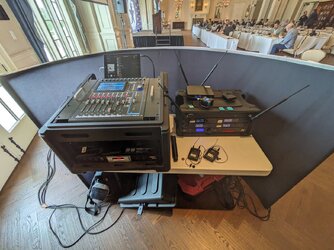
Mix, the system I was talking about in this case is a digital mixer with a parametric eq system. It goes way beyond having a high, mid, and low knob.
 
  • Like
Reactions: sonic-vision
To the broader point... he was asking about are there questions with these style speakers. The RCF Evox-12 is considered a competent speaker in the circles I run in. But I found it to be un-useable in this instance.

I could have been making mistakes at every other level in the situations I'm talking about. I would have preferred handheld mics that aren't as twitchy, but the event organizers wanted lapels. Gain structure, mic placement, etc... all undoubtedly important. And the adjustments I have made make me feel more comfortable with what I'm doing on these types of gigs. But I specifically brought up the speakers because removing them improved my results in a meaningful way. So I was just trying to give him some fodder for the panel he is hosting.
 
To the broader point... he was asking about are there questions with these style speakers. The RCF Evox-12 is considered a competent speaker in the circles I run in. But I found it to be un-useable in this instance.
What I read is that you conducted a test of your mic choice - not the speakers.
The broader point is: was the setup realistic? We can't call the speakers "unusable" if the applied parameters are unstated.
  • What type of element did you use on the Lavs?
  • Where were the speakers placed in relation to the walls?

It is far less costly to change microphones than it is to change speakers. Good questions would be:

"What kind of mics should I be using with stick speakers in a ________________ type gig?"
"What kind of speaker placement should I make in various type/shape rooms?
"What kind of changes should I make for different applications?
"Why are the carry bags always sold separately?" :)


I did a meeting earlier this year with stick speakers (Evolve 50 pair) and the person speaking wore a Lavalier while wandering about. They actually moved to within 3ft of the front of the speaker stick. Not even a hint of feedback! I was pretty amazed because I was following that very closely expecting the sound to at least start to echo, and it didn't. I'm not suggesting the stick speakers have some unique edge. Clearly I know how to match the correct mic type to a gig, hence we do need variety in our mic types or the assessments we make about speakers have little meaning.

A week later at a larger meeting I found a ceiling to my sound level using these same speakers in a gym that was all cinderblock walls. While this can be an issue with all speakers - it was particularly limiting when using wide dispersion stick speakers in that kind of cold hard-wall space. As I mentioned - increased similar energy reflections become an issue for every mic type.

Using the picture you posted as an example - if the box speakers (90-60 at best) were switched to stick speakers (90 to 120) their placement would have to be inline with the front edge of the stage, and closer together due to differences in dispersion, rear field energy, and reflectivity.
 
Last edited:
What I read is that you conducted a test of your mic choice - not the speakers.
The broader point is: was the setup realistic? We can't call the speakers "unusable" if the applied parameters are unstated.
  • What type of element did you use on the Lavs?
  • Where were the speakers placed in relation to the walls?

It is far less costly to change microphones than it is to change speakers. Good questions would be:

"What kind of mics should I be using with stick speakers in a ________________ type gig?"
"What kind of speaker placement should I make in various type/shape rooms?
"What kind of changes should I make for different applications?


I did a meeting earlier this year with stick speakers (Evolve 50 pair) and the person speaking wore a Lavalier while wandering about. They actually moved to within 3ft of the front of the speaker stick. Not even a hint of feedback! I was pretty amazed because I was following that very closely expecting the sound to at least start to echo, and it didn't. I'm not suggesting the stick speakers have some unique edge. Clearly I know how to match the correct mic type to a gig, thus we do have to have variety in our mic types or the assessments we make about speakers is meaningless.

A week later at a larger meeting I found a ceiling to my sound level using these same speakers in a gym that was all cinderblock walls. While this can be an issue with all speakers - it was particularly limiting when using wide dispersion stick speakers in that kind of cold hard-wall space. As I mentioned - increased similar energy reflections become an issue for every mic type.

By and large - I find most of the stick speakers DJs choose for a gig to be under-powered. That's likely due to the cost. I find DJs typically using 2 sets (often different models) for having bought the smaller or lesser powered units. I think it's important to remember that this design's primary release was as: "personal monitor" systems - performances more akin to what Rick might be doing with live nights out.

If I had to supply a question - it would be "why are the carry bags always sold separately?" :)

I'm currently using the Acacia Audio LIZ Headworn, which is also what I prefer to put on wedding officiants.

When I was having the issues I'm referencing a couple of years ago, I was primarily using the Countryman B3. I also have the Shure WL93 Omnis, and I experimented with one of the Shure cardioid mics (I'm not sure exactly which model).

While the carioid felt appealing because I thought it might have better off-axis rejection, I found that speakers were moving their heads too much in how they talked naturally to get a consistent good sound. They'd be talking to the host on one side and then change directions to speak to another panelist.

I'll make another post about this because I don't want to hi-jack this one. But I'm actually about to sell that Evox-12 system. I'm moving away from them on the high end with the RCF NXL 14A over 18-AX combo. And I'm buying a more portable solution of having the J8s for situations where I need to hand carry a rig versus having rolling access. So I'm trying to add a lot of headroom in terms of what I can handle on the high end while having a lighter nimble package for smaller gigs.
 
  • Like
Reactions: Scott Hanna
What I read is that you conducted a test of your mic choice - not the speakers.
The broader point is: was the setup realistic? We can't call the speakers "unusable" if the applied parameters are unstated.
  • What type of element did you use on the Lavs?
  • Where were the speakers placed in relation to the walls?

It is far less costly to change microphones than it is to change speakers. Good questions would be:

"What kind of mics should I be using with stick speakers in a ________________ type gig?"
"What kind of speaker placement should I make in various type/shape rooms?
"What kind of changes should I make for different applications?
"Why are the carry bags always sold separately?" :)


I did a meeting earlier this year with stick speakers (Evolve 50 pair) and the person speaking wore a Lavalier while wandering about. They actually moved to within 3ft of the front of the speaker stick. Not even a hint of feedback! I was pretty amazed because I was following that very closely expecting the sound to at least start to echo, and it didn't. I'm not suggesting the stick speakers have some unique edge. Clearly I know how to match the correct mic type to a gig, thus we do have to have variety in our mic types or the assessments we make about speakers is meaningless.

A week later at a larger meeting I found a ceiling to my sound level using these same speakers in a gym that was all cinderblock walls. While this can be an issue with all speakers - it was particularly limiting when using wide dispersion stick speakers in that kind of cold hard-wall space. As I mentioned - increased similar energy reflections become an issue for every mic type.

Using the picture you posted as an example - if the box speakers (90-60 at best) were switched to stick speakers (90 to 120) their placement would have to be inline with the front edge of the stage, and closer together due to differences in dispersion, rear field energy, and reflectivity.

Ok... so the gig in particular that was really challenging was actually that same room, but was set up like this:

PXL_20211104_234002584.jpg

I would have loved to get those speakers in front of the stage. That was not an option that was made available to me.
 
Maybe "un-usable" is hyperbole. But switching to a different speaker as well as making other adjustments in an effort to create more headroom has made the situation better when I've had to do similar work since then. I was specifically speaking to the speaker itself because this thread was intended to be about speakers.
 
Ok... so the gig in particular that was really challenging was actually that same room, but was set up like this:

I would have loved to get those speakers in front of the stage. That was not an option that was made available to me.
I can't tell if the image is distorted (fish eye) but, it looks like a wide stage and the speakers are too far apart.

You would not think of this as a case of being "under powered" but that is essentially what is going on. As you turn up the volume you are filling the void between speakers with reflections off the rear and side walls and that energy finds it's way right back into your mics. It's further exacerbated when the speaker is located at either side of the stage where the now turned up speakers are also producing more rear field energy.

The physical analogy would be hurling a tennis ball at your garage door with enough speed that it bounces all the way back for you to catch. This is the game your speakers are playing with the microphone.

To improve this, use more speakers at lower volumes, such as adding small front fill monitors to the stage and placing delays half way back along the sides. You are adding "more power" but focusing it directly upon the untreated areas rather than bouncing it back from two discreet point sources. This is the same principle used in flown line arrays. They are not merely a string of more speakers or power - each segment is discreetly focused and energized to serve one specific area or slice of the sound field.

It's easy to mistake "reflection" as a sound that resembles reverb, or noticeable time offset. That's not going to be the case in many indoor spaces where the distances are relatively short. We easily under estimate the power of these reflections when there is no obvious 'slap back.' I do a lot of outdoor events like commencements, and it's here where you get an appreciation of just how powerful sound reflections can be when we hear the delayed echo slap back from a building a little less than a tenth of a mile away.
 
Last edited:
  • Like
Reactions: DJ Bobcat
I can't tell if the image is distorted (fish eye) but, it looks like a wide stage and the speakers are too far apart.

You would not think of this as a case of being "under powered" but that is essentially what is going on. As you turn up the volume you are filling the void between speakers with reflections off the rear and side walls and that energy finds it's way right back into your mics. It's further exacerbated when the speaker is located at either side of the stage where the now turned up speakers are also producing more rear field energy.

The physical analogy would be hurling a baseball at your garage door with enough speed that it bounces all the way back for you to catch. This is the game your speakers are playing with the microphone.

To improve this, use more speakers at lower volumes, such as adding small front fill monitors to the stage and placing delays half way back along the sides.

I believe you are correct.

At the time, I was trying to get the speakers further from the stage because having them against the wall and close I was going to have the stage directly in the dispersion pattern of the speaker. So I spread them further to try to get the mic elements out of the direct firing range. Using a front fill would have been much better to not have to push the mains so hard. But I just wasn't set up in way to have independent control over it at the time, which is what I would have wanted. I didn't want it to just be daisy chained to the mains.

I was underprepared for this when it happened. It's a room I work in a lot, I'm actually there this coming Sunday. I knew those speakers can fill the whole space and thensome, so I wasn't worried about being under-powered. But this was a very different animal, and it had different challenges.
 
I can’t think of a question off hand, but I’ll be interested to hear what opinions people have. I’ve been extremely happy with the results for the last 19 years with my sticks:)
 
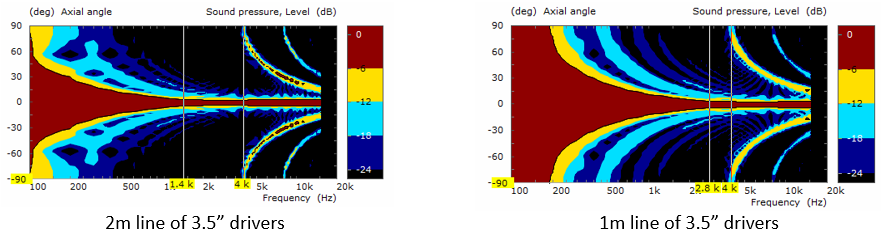
Here is an example of what this session will cover.

This pic shows the dispersion differences between a 1 meter and 2 meter long array of 3.5" speakers. Note how the ideal radiation properties cover a much smaller frequency band with shorter arrays.

1759234673064.png

This pic shows the floor reflection of a 1 meter array placed one 1 meter above the floor. This is the typical of many column arrays where the array sits on a spacer on top of the sub.
1759234779742.png
 
  • Like
Reactions: Scott Hanna
I'm currently using the Acacia Audio LIZ Headworn, which is also what I prefer to put on wedding officiants.

When I was having the issues I'm referencing a couple of years ago, I was primarily using the Countryman B3. I also have the Shure WL93 Omnis, and I experimented with one of the Shure cardioid mics (I'm not sure exactly which model).
The Acacia as a head set benefits when properly placed, but the podium version isn't a good choice. Headsets will solve the turning head issue, but many presenters are not going to want a mic on their face, and especially if it's being video recorded or live streamed.

The turning head issue is solved by using 2 auto-mixed mics, one on each lapel side. This is easier on men than women, and it's best to consult on wardrobe with people ahead of an event too make them aware of what is needed for mics. That includes women having a belt or other accessory capable of holding the bodypack. Politicians, CEOs and TV personalities already know this stuff - but your average local non-profit presenter may not be aware. Good mic placement goes a long way to resolving a turning head and so does creating a stage condition conducive to good mic capture. That means creating a triangle rather than a straight line when setting up discussions on a stage, so heads don't need to swing left to right. Provide a video monitor for podium positions so a presenter doesn't have to look over their shoulder when referring to Powerpoint slides.

Omni mics are not good for live event presentation. They are for recording and broadcasting where there is no PA system to generate feedback, stage dramas in a theater setting, etc. The Shure WL93 is popular in high schools and drama clubs. It's a cheap and discreet way to capture all kinds of audio; easily hidden in a wig, hairline or lapel - but like any omni mic it's going to be difficult to use in a live sound field. The Countryman B3 is also an omni. All headset mics are fragile and break easily - so our need for an expensive element really needs to be there and great care should be taken with headset mics if we don't want to keep buying new ones.

For a podium mic get something in a better price class like an Audio-Technica U857QLU or better. You don't have to pay the $400-$500 these mics may list for since there are so many used and installation overstock items on sites like ebay. The $99 podium mics are for churches and schools where the sound system design carefully accounts for their placement, the audience is captive, and the application narrowly defined. An Acacia podium could be used as a choral mic. I often use a set of 4 similar podium mics to get a chorus into the mix.

_______________
A moderator can separate these posts from the thread as they see fit - but the nature and popularity of the stick speakers at events really does speak to an even greater need to be conscious of how we select and place microphones. It presents significant and often unexpected changes in the level and strength of reflections we might encounter fi we are not fully aware of their specifications and what that means with respect to the architecture around us.
 
Last edited:
  • Like
Reactions: DJ Bobcat
  • Here is an example of what this session will cover.

    This pic shows the dispersion differences between a 1 meter and 2 meter long array of 3.5" speakers. Note how the ideal radiation properties cover a much smaller frequency band with shorter arrays.

    View attachment 56203

    This pic shows the floor reflection of a 1 meter array placed one 1 meter above the floor. This is the typical of many column arrays where the array sits on a spacer on top of the sub.
    View attachment 56204
    Currently using the pro32’s and pro16’s. These are the specs…according to their marketing.
    IMG_8517.png
 
The Acacia as a head set benefits when properly placed, but the podium version isn't a good choice. Headsets will solve the turning head issue, but many presenters are not going to want a mic on their face, and especially if it's being video recorded or live streamed.

The turning head issue is solved by using 2 auto-mixed mics, one on each lapel side. This is easier on men than women, and it's best to consult on wardrobe with people ahead of an event too make them aware of what is needed for mics. That includes women having a belt or other accessory capable of holding the bodypack. Politicians, CEOs and TV personalities already know this stuff - but your average local non-profit presenter may not be aware. Good mic placement goes a long way to resolving a turning head and so does creating a stage condition conducive to good mic capture. That means creating a triangle rather than a straight line when setting up discussions on a stage, so heads don't need to swing left to right. Provide a video monitor for podium positions so a presenter doesn't have to look over their shoulder when referring to Powerpoint slides.

Omni mics are not good for live event presentation. They are for recording and broadcasting where there is no PA system to generate feedback, stage dramas in a theater setting, etc. The Shure WL93 is popular in high schools and drama clubs. It's a cheap and discreet way to capture all kinds of audio; easily hidden in a wig, hairline or lapel - but like any omni mic it's going to be difficult to use in a live sound field. The Countryman B3 is also an omni. All headset mics are fragile and break easily - so our need for an expensive element really needs to be there and great care should be taken with headset mics if we don't want to keep buying new ones.

For a podium mic get something in a better price class like an Audio-Technica U857QLU or better. You don't have to pay the $400-$500 these mics may list for since there are so many used and installation overstock items on sites like ebay. The $99 podium mics are for churches and schools where the sound system design carefully accounts for their placement, the audience is captive, and the application narrowly defined. An Acacia podium could be used as a choral mic. I often use a set of 4 similar podium mics to get a chorus into the mix.

_______________
A moderator can separate these posts from the thread as they see fit - but the nature and popularity of the stick speakers at events really does speak to an even greater need to be conscious of how we select and place microphones. It presents significant and often unexpected changes in the level and strength of reflections we might encounter fi we are not fully aware of their specifications and what that means with respect to the architecture around us.
Mix don’t you have an option this???