... I'm curious if I was unique in that experience with that speaker. Is that design optimized for music in a way that it sacrifices badly on a vocal focused presentation?
Once you get to lapel mics (and an over-ear or headset isn't very different) you have unique challenges no matter what speakers you use. Mic placement is the #1 priority - and
orientation is even more critical than simply getting closer. There are whole mic kits of things designed to create a proper mic placement.
The mic issues don't owe directly to the stick speakers.
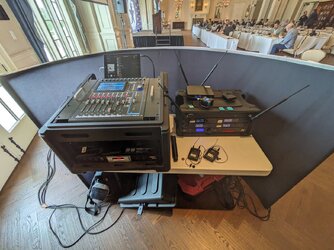
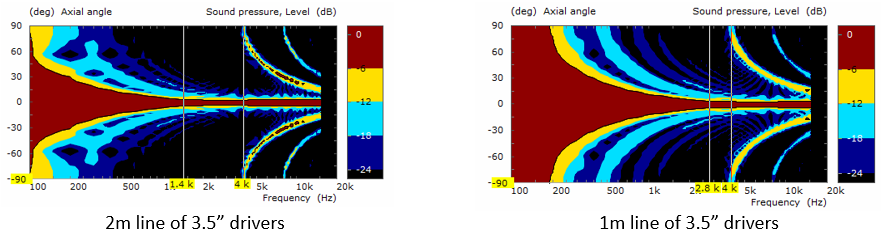
I've used Evolve 50's six times in the past 8 weeks for presentation (Lav mic) plus a town meeting (8 podium mics, 4 RF handhelds). Stick speakers have to be evaluated on the basis of the vertical dispersion as well as the horizontal. They produce a LOT of reflections when walls and ceilings are relatively close. For example, some of these speakers have a horizontal dispersion of 120 Deg. producing far more reflections than the typical 60 Deg. two way box. If you place them near a side wall at least a third of the energy will show up as a reflection with a minor time shift. Time shift is what impacts
intelligibility - that instance where you can hear the voice but not understand what is being said.
The vertical dispersion might be 60 Deg. and vertical reflections could be a problem if they are raised off the floor (stages) and when there are ceiling abutments (soffits) that reach into the sound field.
A wide horizontal dispersion also reduces the notch (or dead zone) between/behind the speakers where your presenter may be. That notch is your high frequency feedback protection. There is no low frequency protection (bass is omnidirectional) so when it comes to EQ a Low Cut is absolutely necessary.
For EQ, there are 5 baseline points that can be relevant to just about any mic before we even show up. Low Cut, High Shelf, 200Hz, 500Hz, 1kHz. The first two are almost fully predictable, because they are safeguards and there is largely no voice in either of those ranges. The others are common to amplified sound systems, will vary somewhat and should simply be at the ready. If they are needed the issue will not be too far away from those predicted frequencies. PEQ is far better than a Graphic EQ at preserving the original sound of the voice.
A feedback eliminator is more useful for an unattended system operating in the same space repeatedly. It can be used to ring-out a room for a little more headroom, but once an audience arrives your acoustics will change and new realities will pop up, or reflections causing feedback in an empty room might disappear once it's filled with people. It could easily turn into a game of whack-a-mole if a proper EQ is not set first. Feedback "eliminator" is also a misnomer because you're going to hear each intrusion at least once before an auto-filter takes affect.
If your active speakers have a "voice" mode - USE it. Eliminate the frequencies you don't need or want before they can leave the speaker rather than waiting for them to reach your EQ. That will simplify a lot of the work right up front. Positioning is also key - keep your mic out of the speaker field, and change to a more appropriate microphone type if you cannot. Frequency cancellations will occur if you allow the same voice coming out of the speakers to return through the mic. We've all heard the reverb that can occur in this fashion, and if you listen carefully you'll also hear the tonal changes and distortions.
All of these apply to the
Live Sound System. Something different can be a applied to a recording or press feed, or done later in post. What's much harder to do in post - is compensation for a poor live mix.
PS: . . and this tip is specific to DJs: Don't try to 'shape" or enhance a speakers voice. It should sound just as natural as it does without the PA system. All of the things a vocalist might want to do for a musical performance
do not apply to presentation. It's a distraction to the audience and a wrench you are effectively throwing into your own EQ and level pursuits.