



What Type Of System Is This? (The Real Poll)
- Thread starter ahoustondj
- Start date
You are using an out of date browser. It may not display this or other websites correctly.
You should upgrade or use an alternative browser.
You should upgrade or use an alternative browser.
- Status
- Not open for further replies.

The .1/.2 nomenclature is only a home theater thing ..
I know but it was the best way I could describe it....
djsarge
Mac Daddy DJ

Rob and Precisionpower have nailed it. Except ,with Rob's explanation he stopped just short of saying the one way part in the sub is already present in the two way box. It does not matter which woofer goes lower, there is nothing in there that separates the low notes between the two woofers (Sub and one in the two way cabinet)Can I change my answer again..... I didn't read the entire thread..... so I'm changing my answer back to Other - 2.1-Way.... meaning since a full range signal is being sent to the 2-way Tops there is your 2-way... and since that same full range signal is being sent to a sub that is the .1-way part.
The correct answer is 3-way, but good guess. Show me a sub and the woofer of a 2-way cabinet (and a pair that would be used with each other, not some specimen on the opposite fringe) that have the same frequency response, and I'll agree .. until then, it will be a 3-way.
In the original question show me the one device that takes the Full Range signal and separates it into Highs, Mids and Lows each one going to a different transducer.The correct answer is 3-way, but good guess. Show me a sub and the woofer of a 2-way cabinet (and a pair that would be used with each other, not some specimen on the opposite fringe) that have the same frequency response, and I'll agree .. until then, it will be a 3-way.
And I repeat, the drivers DO NOT need to be in the same box, and in fact DO NOT need a crossover to be a multi-way system (same as your scoops/mids/802). And it's not what they get, it's what they reproduce. The sub reproduces 35-150Hz (or whatever its specs are), the top woofer reproduces 60Hz-1500Hz (or again whatever it's physical capability is) and the tweeter the rest. You seem to be hung up on the woofer in the top and the sub both getting the same full-range signal. That is true from an input standpoint, but they surely do not reproduce the same frequencies and not at the same efficiency unless you pick some incompatible top/sub combination (and that has to be assumed since you did not specify). So it may not be an ideal 3-way (probably a heavy overlap if there is no setting on the top), but a 3-way none-the-less. It would be a 2-way if the 2 low freq drivers were set up to cover the same band, and given that the sub is low-passed (your description) it won't go above 150Hz.In the original question show me the one device that takes the Full Range signal and separates it into Highs, Mids and Lows each one going to a different transducer.
I never said the woofer on the top is getting the same full range signal did I!!!! What I said was the two way box was getting the same signal as what was going to the sub. The passive filter in there is what does the split.And I repeat, the drivers DO NOT need to be in the same box, and in fact DO NOT need a crossover to be a multi-way system (same as your scoops/mids/802). And it's not what they get, it's what they reproduce. The sub reproduces 35-150Hz (or whatever its specs are), the top woofer reproduces 60Hz-1500Hz (or again whatever it's physical capability is) and the tweeter the rest. You seem to be hung up on the woofer in the top and the sub both getting the same full-range signal. That is true from an input standpoint, but they surely do not reproduce the same frequencies and not at the same efficiency unless you pick some incompatible top/sub combination (and that has to be assumed since you did not specify). So it may not be an ideal 3-way (probably a heavy overlap if there is no setting on the top), but a 3-way none-the-less. It would be a 2-way if the 2 low freq drivers were set up to cover the same band, and given that the sub is low-passed (your description) it won't go above 150Hz.
Using your mode of understanding, if I was to send a signal out of my mixer to a QSC K 12 and the same signal to a JBL Eon 515 that would then make it a Four Way system! Those 4 components are all different, the two woofers are different and the two highs are also different. I think not!
The only way it would be three way is if each one of those three transducers/drivers were getting a dedicated signal with cut off points between each.
This can be achieved using the following options:
A. An active Three Way Crossover (External or Internal)
B. Passive Three Way Crossover (Usually Internal)
C. Three DSP Amps that can set the three different ranges.
I never said the woofer on the top is getting the same full range signal did I!!!! What I said was the two way box was getting the same signal as what was going to the sub. The passive filter in there is what does the split.
First, with an active top (your spec), there isn't a passive crossover, it is active.
Using your mode of understanding, if I was to send a signal out of my mixer to a QSC K 12 and the same signal to a JBL Eon 515 that would then make it a Four Way system! Those 4 components are all different, the two woofers are different and the two highs are also different. I think not!
No ..As the 2 woofers and the 2 tweeters are designed to cover the same basic frequency spectra, so it would be a dual 2-way.
The only way it would be three way is if each one of those three transducers/drivers were getting a dedicated signal with cut off points between each.
This can be achieved using the following options:
A. An active Three Way Crossover (External or Internal)
B. Passive Three Way Crossover (Usually Internal)
C. Three DSP Amps that can set the three different ranges.
Absolutely not .. There does not need to be 3 amps, or a crossover, though typically there is one. What makes it a 3 way is 3 separate transducers, each reproducing and targeting a different part of the overall frequency curve given as an input. As an example (see earlier) many cheap 2-way systems have a piezo tweeter paralleled with a woofer. The piezo will handle a full-range signal but only reproduce frequencies above a certain point. No crossover and a 2-way.
While a 3 way system SHOULD have a mechanism to cleanly divide the spectra (whether a passive or active crossover or some combination), it most certainly is not required. In your example, the sub has a crossover and the top has a crossover (both active) .. the missing piece is a crossover between the sub and top. It would make it sound better (most likely), but by design, the sub has built in limits and by physics, the top also has a lower one, so the 3 separate transducers each get targeted to a different portion of the spectra with some overlap.
Some answers above in Red. Bottom line is the Two way speaker is already reproducing Bass. The filter in it, whether active or passive, is only separating mids and highs from lows.First, with an active top (your spec), there isn't a passive crossover, it is active. Does not matter, it is still a filter in there. Not all Powered speakers have active filters either. Some have just an onboard amp the filter can remain passive.
No ..As the 2 woofers and the 2 tweeters are designed to cover the same basic frequency spectra, so it would be a dual 2-way. Not really, manufacturers specs are not identical.
Absolutely not .. There does not need to be 3 amps, or a crossover, though typically there is one. What makes it a 3 way is 3 separate transducers, each reproducing and targeting a different part of the overall frequency curve given as an input.Thank you very much for confirming that for me. This is exactly my point.As an example (see earlier) many cheap 2-way systems have a piezo tweeter paralleled with a woofer. The piezo will handle a full-range signal but only reproduce frequencies above a certain point. No crossover and a 2-way.
While a 3 way system SHOULD have a mechanism to cleanly divide the spectra (whether a passive or active crossover or some combination), it most certainly is not required. In your example, the sub has a crossover and the top has a crossover (both active) .. the missing piece is a crossover between the sub and top. It would make it sound better (most likely), but by design, the sub has built in limits and by physics, the top also has a lower one, so the 3 separate transducers each get targeted to a different portion of the spectra with some overlap.
Two way is Mid/Highs and Lows
Three way is High, Mids and Lows
Four Way is Highs, Mids, Mid Lows and Lows.
If it is a Three Way, in the system described, can you then tell me which transducer is producing ONLY Midrange?

Some answers above in Red. Bottom line is the Two way speaker is already reproducing Bass. The filter in it, whether active or passive, is only separating mids and highs from lows.
Two way is Mid/Highs and Lows
Three way is High, Mids and Lows
Four Way is Highs, Mids, Mid Lows and Lows.
If it is a Three Way, in the system described, can you then tell me which transducer is producing ONLY Midrange?
I'll present 2 paths using all of the logic presented (and my live x's as the example)
Path 1 ('with sub' not selected): the full range signal would go into the 2 way cab and be broken into 2 signals, HF (to the tweeter) and LF (to the 12" driver), which is only capable of reproducing certain frequencies. The sub also gets a full range signal and drops everything except what it can reproduce (which is LF, below the 12"). Would this not be a 3 way as described?
High, Mid and Low (possibly some overlap between the 12 and the 18)
Path 2 ('with sub' selected): the full range signal would go into the 2 way cab and be broken into 2 signals, HF (to the tweeter) and LF (up to the lowest point the 'with sub' allowed) (to the 12" driver), which will only reproducing specific frequencies. The sub also gets a full range signal and drops everything except what it can reproduce (which is LF, below the 12"). Would this not be a 3 way as described?
High, Mid and Low (no overlap between the 12 and the 18)
Some answers above in Red. Bottom line is the Two way speaker is already reproducing Bass. The filter in it, whether active or passive, is only separating mids and highs from lows.
Two way is Mid/Highs and Lows
Three way is High, Mids and Lows
Four Way is Highs, Mids, Mid Lows and Lows.
If it is a Three Way, in the system described, can you then tell me which transducer is producing ONLY Midrange?
There is no driver producing only midrange (again, not a requirement of a 3-way system). The drivers are reproducing highs (the tweeter in the 2-way), mid/low-mid/high-bass (the woofer in the 2-way), and low-bass (the sub).
Given a sound spectrum of 20-20,000Hz, there are many ways to split it into 3 pieces. You could do 40-100,100-2000,2000+ (a typical 3-way). You could do 40-90, 90-1500, 1500+ ( a system with maybe a 15" bass driver in the upper cab). Or you could do what would be your "test" system, which is probably something like 40-100, 65-2000, 2000+ (with heavy overlap in the low bass without a crossover), still making it a 3-way.
Let's even assume both the top and the sub have 15" drivers. Given the top 15 has to reproduce a decent mid as well, the crossover (whether active or passive) would be designed to roll it off differently than the sub's, which would have been designed with a top end of no more than say 150Hz. So even given the same full-range signal, the two will handle it differently as they are designed to do different things.
I think we will have to agree to disagree on this one. You are getting into technicalities and specs when you should focus on the design. I did not lay out any technical specs such as roll off parameters etc. I did this for a reason. You are the one interjecting those criteria.There is no driver producing only midrange (again, not a requirement of a 3-way system). The drivers are reproducing highs (the tweeter in the 2-way), mid/low-mid/high-bass (the woofer in the 2-way), and low-bass (the sub).
Given a sound spectrum of 20-20,000Hz, there are many ways to split it into 3 pieces. You could do 40-100,100-2000,2000+ (a typical 3-way). You could do 40-90, 90-1500, 1500+ ( a system with maybe a 15" bass driver in the upper cab). Or you could do what would be your "test" system, which is probably something like 40-100, 65-2000, 2000+ (with heavy overlap in the low bass without a crossover), still making it a 3-way.
Let's even assume both the top and the sub have 15" drivers. Given the top 15 has to reproduce a decent mid as well, the crossover (whether active or passive) would be designed to roll it off differently than the sub's, which would have been designed with a top end of no more than say 150Hz. So even given the same full-range signal, the two will handle it differently as they are designed to do different things.
In the system I presented there are no selector switches. What you are proposing with your system, switches and all, is a two way with added bass.I'll present 2 paths using all of the logic presented (and my live x's as the example)
Path 1 ('with sub' not selected): the full range signal would go into the 2 way cab and be broken into 2 signals, HF (to the tweeter) and LF (to the 12" driver), which is only capable of reproducing certain frequencies. The sub also gets a full range signal and drops everything except what it can reproduce (which is LF, below the 12"). Would this not be a 3 way as described?
High, Mid and Low (possibly some overlap between the 12 and the 18)
Path 2 ('with sub' selected): the full range signal would go into the 2 way cab and be broken into 2 signals, HF (to the tweeter) and LF (up to the lowest point the 'with sub' allowed) (to the 12" driver), which will only reproducing specific frequencies. The sub also gets a full range signal and drops everything except what it can reproduce (which is LF, below the 12"). Would this not be a 3 way as described?
High, Mid and Low (no overlap between the 12 and the 18)
Differences between 2 way and 3 way loudspeakers
(Oh, and the answer is a 2 way/2.1/or 2 way with added base)
Search for 2-way bookshelf speakers

Search for 3-way bookshelf speakers
Search for 3-way floor standing speakers
What does 2-way and 3-way loudspeaker mean?
If a speaker is referred to as a 2-way loudspeaker it means it has 2 speakers in it. If it is a 3-way loudspeaker it will have 3 speakers in it.
Why do 2 way & 3 way loudspeakers have more than one speaker?
Different sound waves are reproduced better by different speaker sizes. High pitched sounds like cymbals require a speaker to move very fast to reproduce the sound, as where low frequency sounds like a bass drum or guitar require a much larger speaker to move a greater volume of air. Although you could have one speaker to do both a two-way loudspeakers breaks up the task into two speakers, each specializing in producing a specific range of sounds. This means that each speaker will do a better job of reproducing the sounds within its frequency range. (referred to as frequencies) Low frequencies usually are those below 150Hz while most speakers can produce sound as high as 20kHzFrequency Range
Frequency Range What type of sounds
Very Low under 30Hz Bottom notes on a pipe organ, rumble of explosion - Subwoofer only
Low 30Hz to 160Hz Bass Tuba, Bass Guitar - Woofer
Mid 160Hz to 3kHz Human voice, Trumpet, Sax - Woofer or Midrange
High 3kHz to 20,kHz Cymbals, Piccolo - Tweeter
Crossovers
To split the sound betwen 2 or 3 speakers, we use something called a crossover. The crossover takes the signal from the amplifier and splits it into 2 or 3 frequency ranges and sending those signals to the speaker best designed to handle those frequencies. In a 2-way speaker, the sound is split between the tweeter and the woofer. The highs go to the tweeter, the lows to the woofer.
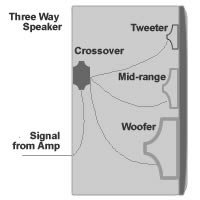 What is the benefit of a 3 way speaker system?
3 way speaker systems include a mid-range driver. This is usually a speaker that is smaller than the woofer in the system, and gets program material in the "middle" of the frequency spectrum. This allows the system to have one speaker that can concentrate on producing things like voices, saxophones and other instruments in this range.
Does a 3-way speaker sound better than a 2-way speaker?
As with all questions involving speakers the answer is a solid "maybe". Although it would seem that splitting the signal into 3 ranges would increase the accuracy of the music reproduction of a speaker, it depends on how well the crossover is "tuned" (setup) and several other items including cabinet design, how well the other speakers are matched to each other, the listening room and what type of sound you like.
(Oh, and the answer is a 2 way/2.1/or 2 way with added base)
Search for 2-way bookshelf speakers
Search for 3-way bookshelf speakers
Search for 3-way floor standing speakers
What does 2-way and 3-way loudspeaker mean?
If a speaker is referred to as a 2-way loudspeaker it means it has 2 speakers in it. If it is a 3-way loudspeaker it will have 3 speakers in it.
Why do 2 way & 3 way loudspeakers have more than one speaker?
Different sound waves are reproduced better by different speaker sizes. High pitched sounds like cymbals require a speaker to move very fast to reproduce the sound, as where low frequency sounds like a bass drum or guitar require a much larger speaker to move a greater volume of air. Although you could have one speaker to do both a two-way loudspeakers breaks up the task into two speakers, each specializing in producing a specific range of sounds. This means that each speaker will do a better job of reproducing the sounds within its frequency range. (referred to as frequencies) Low frequencies usually are those below 150Hz while most speakers can produce sound as high as 20kHzFrequency Range
Frequency Range What type of sounds
Very Low under 30Hz Bottom notes on a pipe organ, rumble of explosion - Subwoofer only
Low 30Hz to 160Hz Bass Tuba, Bass Guitar - Woofer
Mid 160Hz to 3kHz Human voice, Trumpet, Sax - Woofer or Midrange
High 3kHz to 20,kHz Cymbals, Piccolo - Tweeter
Crossovers
To split the sound betwen 2 or 3 speakers, we use something called a crossover. The crossover takes the signal from the amplifier and splits it into 2 or 3 frequency ranges and sending those signals to the speaker best designed to handle those frequencies. In a 2-way speaker, the sound is split between the tweeter and the woofer. The highs go to the tweeter, the lows to the woofer.
3 way speaker systems include a mid-range driver. This is usually a speaker that is smaller than the woofer in the system, and gets program material in the "middle" of the frequency spectrum. This allows the system to have one speaker that can concentrate on producing things like voices, saxophones and other instruments in this range.
Does a 3-way speaker sound better than a 2-way speaker?
As with all questions involving speakers the answer is a solid "maybe". Although it would seem that splitting the signal into 3 ranges would increase the accuracy of the music reproduction of a speaker, it depends on how well the crossover is "tuned" (setup) and several other items including cabinet design, how well the other speakers are matched to each other, the listening room and what type of sound you like.
Canute, it's the technicalities that make the system what it is and if you focus on the design, you will get what I laid out. There really isn't a definition of a system with "added bass".
I know you think it is something else, but you haven't laid out ANY logic to derive a different outcome. Please elaborate on why you believe it is not a 3-way and I'll be happy to discuss.
I know you think it is something else, but you haven't laid out ANY logic to derive a different outcome. Please elaborate on why you believe it is not a 3-way and I'll be happy to discuss.
This is not a three way system as it DOES NOT split bass/mid/high.
It produces High / Mid-low / only low
It produces High / Mid-low / only low
And you have the "textbook" 3-way (or Wikipedia one anyway), but not the ONLY 3-way setup.Differences between 2 way and 3 way loudspeakers
(Oh, and the answer is a 2 way/2.1/or 2 way with added base)
Search for 2-way bookshelf speakers
Search for 3-way bookshelf speakers
Search for 3-way floor standing speakers
What does 2-way and 3-way loudspeaker mean?
If a speaker is referred to as a 2-way loudspeaker it means it has 2 speakers in it. If it is a 3-way loudspeaker it will have 3 speakers in it.
Why do 2 way & 3 way loudspeakers have more than one speaker?
Different sound waves are reproduced better by different speaker sizes. High pitched sounds like cymbals require a speaker to move very fast to reproduce the sound, as where low frequency sounds like a bass drum or guitar require a much larger speaker to move a greater volume of air. Although you could have one speaker to do both a two-way loudspeakers breaks up the task into two speakers, each specializing in producing a specific range of sounds. This means that each speaker will do a better job of reproducing the sounds within its frequency range. (referred to as frequencies) Low frequencies usually are those below 150Hz while most speakers can produce sound as high as 20kHzFrequency Range
Frequency Range What type of sounds
Very Low under 30Hz Bottom notes on a pipe organ, rumble of explosion - Subwoofer only
Low 30Hz to 160Hz Bass Tuba, Bass Guitar - Woofer
Mid 160Hz to 3kHz Human voice, Trumpet, Sax - Woofer or Midrange
High 3kHz to 20,kHz Cymbals, Piccolo - Tweeter
Crossovers
To split the sound betwen 2 or 3 speakers, we use something called a crossover. The crossover takes the signal from the amplifier and splits it into 2 or 3 frequency ranges and sending those signals to the speaker best designed to handle those frequencies. In a 2-way speaker, the sound is split between the tweeter and the woofer. The highs go to the tweeter, the lows to the woofer.
What is the benefit of a 3 way speaker system?
3 way speaker systems include a mid-range driver. This is usually a speaker that is smaller than the woofer in the system, and gets program material in the "middle" of the frequency spectrum. This allows the system to have one speaker that can concentrate on producing things like voices, saxophones and other instruments in this range.
Does a 3-way speaker sound better than a 2-way speaker?
As with all questions involving speakers the answer is a solid "maybe". Although it would seem that splitting the signal into 3 ranges would increase the accuracy of the music reproduction of a speaker, it depends on how well the crossover is "tuned" (setup) and several other items including cabinet design, how well the other speakers are matched to each other, the listening room and what type of sound you like.
This is not a three way system as it DOES NOT split bass/mid/high.
It produces High / Mid-low / only low
Just wanted to reiterate.
Thank you for that answer. Now repeat that loudly so Steve can hear you.This is not a three way system as it DOES NOT split bass/mid/high.
It produces High / Mid-low / only low
- Status
- Not open for further replies.