

Extreme System Makeover - FREE!

To many ads? Support ODJT and see no ads!

NLFX Pro

Well-Known DJ
Jan 6, 2007
2,707
56
50
www.nlfxpro.com
This was inspired by a number of "what if" threads and "what stuff" threads, and other questions. I've decided to use our system design resources here (normally reserved for large projects because of the tremendous expense associated with the design time... my guys are good and they don't work cheap) to help you make good equipment use and placement decisions. I want the ODJT DJs to be the best in the world. You are like family to me.

Okay guys & gals... submit your typical room dimensions, speaker models and where you would typically place them. We'll pick a few and create some 3D engineering reports. It's not guesswork or trial and error... it's science. Most DJs don't have EASE or SMAART, so it becomes trial and error for you at a gig. We're going to eliminate that for you. We'll model the results for you in EASE and post the renderings here. Then you can see the impact of placement, frequency, beaming, comb filtering, and we'll show some DSP recommendations that will dramatically improve your sound with out any added expense (assuming you have some basic processing equipment). Sort of a "extreme system makeover" if you will.

You can post the info as text dimensions or submt drawings. Crude is fine. The important things for us to know are the dimensions (all 3), any obstacles that might cause shadowing of the sound, and the types of surfaces (concrete, sheetrock, acoustic tile ceiling, carpet over concrete, etc.).

***A warning... EASE is a very pro-level software, and many of the "low end" speaker models may not be available for modeling because their engineers (or lack thereof) have not submitted the data or do not have adequate testing facilities to produce accurate data. I figured I'd better post this since inevitably somebody will wonder why "Brand X" can't be modeled. Some might be very surprised to find out what the Pro Audio industry considers "low end" too. Kinda like those warnings they put on TV shows... the content might offend you, so you might not want to watch.

Ben
 
Wow.......thank you Brutha Benjamin.....that is a very generous offer indeed.

Here's my current HOME stereo setup with room dimensions of the Den (loft):

Room width = 18 feet
Room length = 18 feet
Ceiling height = vaulted ceiling that peaks at 12 feet, goes down to 7 feet (10x12 pitch).
carpeted floor. typical furnishings (sofa, loveseat, wood coffee table, end tables, lamps)

Recently, we added R-19 insulation between the rafters, and covered with 1"x6" Tongue-In-Groove (TnG) western Red Cedar. The surface is treated with Minwax natural wood stain, followed by 2 coats of Minwax indoor polyurethane.

NOTE: the two "back walls" of this room are wrought-iron powder-coated balcony railings, because the room overlooks the dining rooms & living rooms on the first floor. The entire vaulted ceiling was done in the same treatment as the upstairs "loft" den.
The walls behind the speakers are typical drywall, except for the sliding glass door.

Speakers are placed in one corner, to the right of the sliding door. TV & components are stacked in the middle.

SYSTEM COMPONENTS: (most were purchased between 1985 & 1987)

Vandersteen 2ci speakers(pair)
Design Acoustics PS-88 8-inch 2-way (L + R surround speakers)
B & K ST-140 amplifier(100 watts per channel)
Adcom GFP-555 pre-amplifier
Yamaha DSP E-200 surround sound processor (20 wpc on rear channels, Dolby 2.0)
Toshiba DVD-CD player
Pioneer Laserdisc player

Originally, this system had a Velodyne UL-15 subwoofer, but it got blown up in 1989 (using it in my first DJ rig--boy was I an idiot!)

Long ago, I discovered the "Phantom Center Channel" feature on the Yammie DSP, which basically puts the dialog in movies front & center, while at the same time steering the music content into the left or right.

The Vandersteen's have 10" woofers but with the 12" passive radiators produce an incredible amount of low end sound. Not as rumbly as the subwoofer, but its good enough bass--- so we can live without a sub.

I think the vaulted ceilings are the answer, because there is so much wood in this project......the room became a kind of speaker enclosure. (Similar to a folded horn or Klipsch speaker)
 
Ben I should get the blue prints to our local arena, they want me to DJ in there ;-)

Their PA is in disarray, horrible blown horns & wolfers, cross over system, not even bi-amped... Finally the carbon arc spotlights at the top. GEEZE!

---

SMAART is some fun stuff! I'm more in the video so haven't had a big need for it as of yet.
 
Folks, I got to see one of these evaluations...

The program "figures" out everything that affects the distribution of sound in a room. It recommends the placement of speakers, how many, and of what type, in order to get the maximum amount of sound into the room. Then It prints it all out on a 3D type of graphic. Very cool, and a MUST have for state of the art sound engineering.

BTW Ben, I need a delay for my system for the new club (the 4 milisecond thing you told me about at your store).
 
Ben I should get the blue prints to our local arena, they want me to DJ in there ;-)

Their PA is in disarray, horrible blown horns & wolfers, cross over system, not even bi-amped... Finally the carbon arc spotlights at the top. GEEZE!

---

SMAART is some fun stuff! I'm more in the video so haven't had a big need for it as of yet.

PERFECT! Send it over! That's just the kind of thing we specialize in!

Ben
 
Wow.......thank you Brutha Benjamin.....that is a very generous offer indeed.

Here's my current HOME stereo setup with room dimensions of the Den (loft):

Room width = 18 feet
Room length = 18 feet
Ceiling height = vaulted ceiling that peaks at 12 feet, goes down to 7 feet (10x12 pitch).
carpeted floor. typical furnishings (sofa, loveseat, wood coffee table, end tables, lamps)

Recently, we added R-19 insulation between the rafters, and covered with 1"x6" Tongue-In-Groove (TnG) western Red Cedar. The surface is treated with Minwax natural wood stain, followed by 2 coats of Minwax indoor polyurethane.

NOTE: the two "back walls" of this room are wrought-iron powder-coated balcony railings, because the room overlooks the dining rooms & living rooms on the first floor. The entire vaulted ceiling was done in the same treatment as the upstairs "loft" den.
The walls behind the speakers are typical drywall, except for the sliding glass door.

Speakers are placed in one corner, to the right of the sliding door. TV & components are stacked in the middle.

SYSTEM COMPONENTS: (most were purchased between 1985 & 1987)

Vandersteen 2ci speakers(pair)
Design Acoustics PS-88 8-inch 2-way (L + R surround speakers)
B & K ST-140 amplifier(100 watts per channel)
Adcom GFP-555 pre-amplifier
Yamaha DSP E-200 surround sound processor (20 wpc on rear channels, Dolby 2.0)
Toshiba DVD-CD player
Pioneer Laserdisc player

Originally, this system had a Velodyne UL-15 subwoofer, but it got blown up in 1989 (using it in my first DJ rig--boy was I an idiot!)

Long ago, I discovered the "Phantom Center Channel" feature on the Yammie DSP, which basically puts the dialog in movies front & center, while at the same time steering the music content into the left or right.

The Vandersteen's have 10" woofers but with the 12" passive radiators produce an incredible amount of low end sound. Not as rumbly as the subwoofer, but its good enough bass--- so we can live without a sub.

I think the vaulted ceilings are the answer, because there is so much wood in this project......the room became a kind of speaker enclosure. (Similar to a folded horn or Klipsch speaker)

This would be cool... but not a "pro audio" system or environment. Sorry. :(

Ben
 
The program "figures" out everything that affects the distribution of sound in a room. It recommends the placement of speakers, how many, and of what type, in order to get the maximum amount of sound into the room. Then It prints it all out on a 3D type of graphic. Very cool, and a MUST have for state of the art sound engineering.

BTW Ben, I need a delay for my system for the new club (the 4 milisecond thing you told me about at your store).

Thanks TB. Some cool options. We'll talk in Vegas, if not sooner. ;)

Ben
 
Ben I should get the blue prints to our local arena, they want me to DJ in there ;-)

Their PA is in disarray, horrible blown horns & wolfers, cross over system, not even bi-amped... Finally the carbon arc spotlights at the top. GEEZE!

---

SMAART is some fun stuff! I'm more in the video so haven't had a big need for it as of yet.


How did you get such knowledge and technical skills at your age Travis? I must say, I am always impressed with you.
 
How did you get such knowledge and technical skills at your age Travis? I must say, I am always impressed with you.
I research all the time and ask questions... It comes with the territory I guess lol.
 
That's great, Ben. Thanks for your unending support of ODJT. :)

I doubt that our Carvin cabinets would qualify so that lets me out, lol. :D
 
You know the only drawback to Ben's offer? You can't always set-up in the most desirable place for the best sound in every venue that you play, since many times you are at the mercy of the venue director or banquets director. That, and the fact that some of us use different equipment for different venues.

After reading Ben's original offer, it struck me that the design team would have to have every possible and conceivable system configuration that you use in the different venues you play, for optimum blueprints.

For instance, I carry 3 complete audio consoles (redundant, I know) in the trailer at all times and each one of them is different from the other - with the option of mixing and matching the different amps and speakers for each individual application that I wind up facing venue-wise and number of people at each event.

Other than that, I think it's a very very cool idea!
 
This isn't the biggest place I play just the worst....


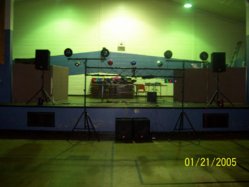
150 Ft long, 78 Ft wide, 55 Ft high. Stage is very large and all enclosed behind me about 3.5 feet off the floor. There is nothing in front of me to cause shadowing of the sound. On the back wall there is some accoustic tile about 35 Ft up reaching to the celing. Below that is Sheetrock to the floor. Looking out from the stage the door is to the far right and the bar is to the far left. The side walls are concrete and sheetrock with windows at the very top. The celing is steel girters and sheetrock on a V angle

I use 2 JBL JRX 115s driven by a Yamaha P5000 and 2 JRX 118s driven by a P7000

The only picture I have is of the stage area
 

Attachments

  • 100_5573.jpg
    100_5573.jpg
    88.2 KB · Views: 3
This isn't the biggest place I play just the worst....


150 Ft long, 78 Ft wide, 55 Ft high. Stage is very large and all enclosed behind me about 3.5 feet off the floor. There is nothing in front of me to cause shadowing of the sound. On the back wall there is some accoustic tile about 35 Ft up reaching to the celing. Below that is Sheetrock to the floor. Looking out from the stage the door is to the far right and the bar is to the far left. The side walls are concrete and sheetrock with windows at the very top. The celing is steel girters and sheetrock on a V angle

I use 2 JBL JRX 115s driven by a Yamaha P5000 and 2 JRX 118s driven by a P7000

The only picture I have is of the stage area

Is the ceiling height in the center? What is the height on the edges or what is the pitch? How deep is the stage? This looks like a perfect situation to model. :)

Ben
 
You know the only drawback to Ben's offer? You can't always set-up in the most desirable place for the best sound in every venue that you play, since many times you are at the mercy of the venue director or banquets director. That, and the fact that some of us use different equipment for different venues.

After reading Ben's original offer, it struck me that the design team would have to have every possible and conceivable system configuration that you use in the different venues you play, for optimum blueprints.

For instance, I carry 3 complete audio consoles (redundant, I know) in the trailer at all times and each one of them is different from the other - with the option of mixing and matching the different amps and speakers for each individual application that I wind up facing venue-wise and number of people at each event.

Other than that, I think it's a very very cool idea!

Exactly. ;) Our designers do have libraries of THOUSANDS of different products.

The beauty of a project like this is to show both the "ideal" scenario, and then working with what you get we can show you the consequences of the new placement, and the best possible response to that situation.

We run into it all the time when we design systems. We often cannot place loudspeakers where they would be acoustically best for a variety of reasons. Either structural support, obstacles, aesthetics, etc. prohibit it. Therefore we design the best possible solution given the restrictions we have. You ca work with delay, parametric eq, etc... to overcome some of these things electronically as well.

Ben
 
Is the ceiling height in the center? What is the height on the edges or what is the pitch? How deep is the stage? This looks like a perfect situation to model. :)

Ben

That is the center of the celing. The edges are about 30 Ft. The stage is about 25 Ft deep and 75ft wide with an opening of about 35 Ft
 
i'm working on getting those dimensions and stuff for you from the owner!
 
Man I wish I had the actual dimentions of the banquet room I'll be using for a valentine's dance

It seats 150 and is your typical rectangle shaped room with 10' drop ceilings... the ceiling tile is that drywallish stuff.... the walls of the room are typical sheetrock... and the room is carpeted and has windows on just one side of the room running the length of the room... there are no obstructions or limitations as to where I can actually setup... typically the back of the room pointing down the length of the room...

I'll be using a pair of Yamaha BR-15 on sticks no sub.... powered by a Nady XA-900, EQ'd by a Behringer DEQ2496 Ultracurve... sound sent to the behringer will be thru an EMU-1820 via S/Pdif Optical then to the amp via XLR from the behringer....

Thoughts?