Device for measuring power draw??

To many ads? Support ODJT and see no ads!
Nov 12, 2007
258
7
68
Niagara Falls Canada
Does anyone know of a devise that you can put between your gear and a wall plug to see how many amps you draw. I'm trying to determine the draw of my gear so I will know what I have left for lighting.

Dean
Niagara Premier DJ's
 
Does anyone know of a devise that you can put between your gear and a wall plug to see how many amps you draw. I'm trying to determine the draw of my gear so I will know what I have left for lighting.

Dean
Niagara Premier DJ's

First you need to know the Power Source eg. 20 amps, then you need to know the total current of the gear you are running. Subtract the latter from the former and you should be in the ballpark.
 
Dean,

They make devices you can pick up at your local Home Depot, Lowe's or other home improvement store that you would plug all your equipment into and it will let you know the real current draw. You'll likely find, particularly in the case of amps, that the rated draw (1500 watts for example) and what they really draw is VERY different. If they drew max power, you would never be able to plug a 2500 watt amp into a 15 amp circuit.

Test your audio under a REAL test load with EVERYTHING plugged into one circuit and add a couple amps wiggle room. The rest is available for lighting (which is MUCH easier to compute).
 
Why in the sam hell would you do that? I don't care if you are pulling the max load or not.

Mike

It was an observation. The max load from a 15 amp circuit is about 1600 watts without losses (or roughly 1HP). You CAN plug in a 2500 watt amp on that circuit and in most cases run it all night as long as you aren't loading it up heavily and it's the only thing on the circuit.

Again, because you CAN do a thing doesn't mean you WANT to do a thing.

That's why I was pointing out the measuring device. A little knowledge goes a LONG way.
 
Yeah there is -- get a Kill A Watt meter. It will tell you what each device is using, up to about 15 amps.


If you need something more, than hire an electrician, and stop listening to the penis measuring debate above... ;) :)
 
Yes the Kill A Watt sounds like what I'm looking for. Right now I have two powered speakers rated at 750 watts each and I also have (7) 75 watt par cans and my projector hooked into one 15 amp circuit. Theoretically I should have blown the breaker but everything seams fine. So the real question is how much power are my speakers actually drawing.

Dean
Niagara Premier DJ's
 
You'll like it -- I use mine all the time. Just plug one thing in at a time, and note the draw, both in watts and amperage.

I only have 60 amps total in my building. So I measure everything out at both normal usage, and max usage -- to see what I can put on any given fuse, and how loud I can turn it up, without changing out said fuses... :)
 
Any ammeter ( Amp Meter) will do, and if you own a multi-meter like a Fluke the function is included.

However, why not just add all of the wattages printed on the plates next to the AC inputs of all your devices, divide by the AC voltage (call it 110) and you have your amperage. Add a suitable safety margin and you're good to go.
 
A clamp on ammeter will measure current. But you need to account for inrush & will see a brief spike when you power up a fixture, equipment piece...

XL-4GA54.JPG
 
Circuit breakers typically allow for overcurrent

Yes the Kill A Watt sounds like what I'm looking for. Right now I have two powered speakers rated at 750 watts each and I also have (7) 75 watt par cans and my projector hooked into one 15 amp circuit. Theoretically I should have blown the breaker but everything seams fine. So the real question is how much power are my speakers actually drawing.

Dean
Niagara Premier DJ's

It is time to get down on Fred because I know he knows this stuff. He's holding out on you guys.

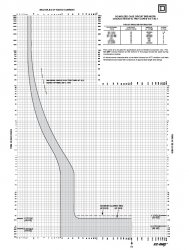
There are many different kinds of breakers with different characteristics. Most commonly, breakers do not open (break) at exactly the rated current. There is some tolerance for additional overcurrent based on the length of time the overcurrent condition exists. It is not inconceivable that an overcurrent condition of ten to twenty-five percent could exist indefinitely on any given breaker.

Here is a typical trip curve:
View attachment 16129

If the above is too small to read, see the original here:
http://ecatalog.squared.com/pubs/Ci...Miniature Circuit Breakers/0720CT9401R105.pdf
flip to page 20

There are many different trip curves. In essence because of the previously mentioned surge currents, momentary overcurrent conditions (that is, you draw more than the rated power from the circuit) are fairly typical. They aren't dangerous if short lived. The alternative, having a breaker trip the moment the current rating were exceeded would not improve safety. It might increase the desire of the end user to replace the correct breaker with an over sized one. Ever hear of the dangerous trick of putting a penny under a old fashioned screw in fuse? If the overcurrent is severe and lasts long enough to heat the wires, a dangerous condition will result. That is the purpose of the breaker, to prevent a dangerous condition rather than specifically limit the circuit to a specified trip point.

Most miniature breakers (less than 100A) are inexpensive and not precisely calibrated devices. When old, breakers they may open at less than rated current. When new, a little fudge factor is allowed.
 

Attachments

  • CB_Trip_Curve.jpg
    CB_Trip_Curve.jpg
    105.4 KB · Views: 4
Wow -- the penis got even bigger... :sqerr: :sqlaugh: :rofl:


Get the kill-a-watt meter dude -- they work fantastic, and can also monitor your AC in. It's not Rockit science -- you plug amplifier into it, you turn knob to 3, you watch current draw, turn to 7, again watch current draw.

I have an AudioSource ref amp I use here -- nothing fancy, but it shows 500 watts draw on the plate. So, when at 5, it's drawing 73 watts. I'm not sure I ever got it all the way to 10, but it might draw 500 then...


Once you get used to using it, it makes life much easier :)


BTW, it's only like < $20.
 
OK... I've got a little time tonight.

Great info has been posted here. Thanks, guys.

As Balanced Line mentioned, circuit breakers do allow for a goodly amount of peak overcurrent. Like heavy bass hits for example. Breakers are of two services ~ thermal and magnetic (short-circuit). A breaker will trip sooner in hot environments. This is known as nusiance tripping.

The clip-on ammeter Joe mentions is my weapon of choice. But I'm an old electrician from way back. Bear in mind, this device will work only when clipped around one conductor on the AC line. It won't give a reading if you clip it on an AC cord. The conductors must be separated and one conductor clipped around for this device to serve.

Device power ratings don't necessarily calculate to your total current draw. For example, a powered cabinet may be rated at 400 watts RMS output. This is not to say that it requires anywhere near 400 watts AC power. Far from it.

We can run our full system on a single 15 amp breaker as long as we don't push it. Put it on a 20A breaker and we can max it out. The lows amp, a 2500 watter feeding two sub boxes bridged at 4 ohms draws at the very most 9 amps. That's pushing it to redline.

Equally important is the quality of AC service you're dealing with. If the service is poor with voltage drop your rig will notice.

I do agree with Rick's mention of the Kill-A-Watt. :)
 
Weenie meter

OK... I've got a little time tonight.


...The clip-on ammeter Joe mentions is my weapon of choice. But I'm an old electrician from way back. Bear in mind, this device will work only when clipped around one conductor on the AC line. It won't give a reading if you clip it on an AC cord. The conductors must be separated and one conductor clipped around for this device to serve...

:)

Some time ago I bought a Radio Shack clamp on 'cause I didn't have much money and needed to know why the customer was popping fuses. It came with a molded accessory cord that allowed the cord to be plugged into the wall and a load to be plugged into the cord. It had two apertures with one and ten turns that multiplied the meter reading by 1X or 10X respectively. Very safe even for a newbie. Although Radio Shack no longer offers the kit it would be very simple to construct the test cord they supplied.

If anyone wants to avoid buying Rick's weenie meter and buy a grown up CLAMP ON man's meter, I'll show them how to construct a cord to safely meter a single plug-in load. You still have to do the math to calculate the watt draw so if you're innumerate get thee to Walmart for a simpler safer weenie meter.
 
Some time ago I bought a Radio Shack clamp on 'cause I didn't have much money and needed to know why the customer was popping fuses. It came with a molded accessory cord that allowed the cord to be plugged into the wall and a load to be plugged into the cord. It had two apertures with one and ten turns that multiplied the meter reading by 1X or 10X respectively. Very safe even for a newbie. Although Radio Shack no longer offers the kit it would be very simple to construct the test cord they supplied.

If anyone wants to avoid buying Rick's weenie meter and buy a grown up CLAMP ON man's meter, I'll show them how to construct a cord to safely meter a single plug-in load. You still have to do the math to calculate the watt draw so if you're innumerate get thee to Walmart for a simpler safer weenie meter.

I was just thinking I should post a picture of the cord I constructed (just like you describe above), but suffice to say that at -22F, I'm not driving down to the office to take a picture of it. LOL.

In my opinion, if you're asking how to do this... the "weenie" meter is probably a great place to start. There is no pride involved here, whatever gets the job done is just fine. ;)

Also, there are Furman (and other brands) power conditioners that will measure both supply voltage, and amperage of the connected equipment. This is pretty useful if you're worried about what you're drawing at a gig.

Ben
 
OMFG. You guys are killing me here...........

Do you want real time monitoring, true rms, peak ampereage, etc, etc, etc, etc, etc, etc,.....and believe me that's not all the etc's on this particular subject. I am a licensed master electrician (day job), specializing in industrial controls. The plethera of products out there is unbelievable for what you want.

You have to account for inrush current, max current, how long the max current will be maintained, and a whole lot more etc's......

The clamp on ammeter shown earlier only works if it clamped on the "Hot" conductor only.

The Kill-A-Watt is a "plug in meter". you plug your gear into it. Then not only is there voltage drop, there is power factor, harmonics, neutral sharing, and some more etc's......

All of the above options require you to be there watching the meter while you are DJ'ing....Keep in mind, your gear will drawing a constantly variable current depending on what your playing. Bass requirements etc......

If you just go by the tags on the back of your gear, it's law that they show max power consumption, add them all together and that will give you the best idea. If the equipment draws more that what the tag says, there is probably damage being done to the gear.

 
The clamp on ammeter shown earlier only works if it clamped on the "Hot" conductor only.

I think someone else also posted this, but I wanted to add my 'thanks' to include that I learned something new tonight. So this type of meter will only work correctly if you isolate (on a 3-wire- black, white, ground) the black wire? I'll admit that I didn't know this previously.

Cheers & Happy New Year.

Joe