

Cabling Connections

To many ads? Support ODJT and see no ads!

ahoustondj

Mac Daddy DJ
Aug 13, 2007
20,235
3,465
Texas
okay I have a question about making your own speaker cables, and I'm curious to see some of the answers. First of all I want to make a disclaimer. I do know that you have to connect positive to positive and negative to negative.

First, if you are using say 14gauge zip cord wire with a stripe down one side, do you used the striped end as positive or negative?

Second,if you are using rounded cable with black and white conductors,do you use the black as negative or positive?

Third, if you are using dual banana plugs with a tab on one side, such as displayed in the photo,do you use the tab side as negative or positive?
A. (in the event that it does not have the red or black markings)
B. {in the event that the red marking is on the tab side)
 

Attachments

  • Banana Plug.jpg
    Banana Plug.jpg
    11 KB · Views: 65
Well... it's six of one or a half-dozen of the other. The important thing is to make up all cables consistently. :)

With zip cord I'd use the conductor with the tracer as positive. For two conductor SO or SJ cord I'd use the black conductor as positive.

For banana plug configuration keep red positive. The tab is there to make it easier to remember which way the plug goes into the jacks. Again, make all cables the same way.

Hope this helps.
 
First, if you are using say 14gauge zip cord wire with a stripe down one side, do you used the striped end as positive or negative?

Edit: I was originally confused with the differences between black/white and black/red designations. Corrected here:

With zip wire, I treat the ribbed side as "black" and the smooth side as "white." So, the ribbed side is "hot" and the smooth side is "neutral".

Second,if you are using rounded cable with black and white conductors,do you use the black as negative or positive?

Edit: I got this wrong the first time (I wrote the red/black section first)...corrected here:

White is neutral (or negative), and black is hot (or positive) when doing household wiring. I use the same convention with audio.

Third, if you are using dual banana plugs with a tab on one side, such as displayed in the photo,do you use the tab side as negative or positive?
A. (in the event that it does not have the red or black markings)
B. {in the event that the red marking is on the tab side)

Red is positive.
Black is negative.

So it is with jumper cables, so it is with speaker wire.

Edit: The banana plug in the photo uses black/red for color coding.

The tab in the photo is shown on the "black" (or negative) side of the plug. That is the convention that I have always used. In either case, I can see the wire colors going to the terminal, and I use that to determine how to plug the things in. In general, I can use the crossover to change polarity....but switching the way a banana is plugged in is just as easy for most people.
 
Except for the zip cord, the two of you are in agreement. I do everything the way that Fred does. What has thrown me for a loop was I recently purchase some dual banana plugs, and they had the tab on the red marker side. I went ahead and connected my positive wire to the red marker side. With no markers and only a tab, I will connect the negative wire to the tab side. Again, as long as you have positive to positive and negative to negative, there should be no problem. As Fred said, it is best to keep everything consistent.
 
JK is right, I'm not an electrician or anything close to it but when I built my power distro I followed the diagrams and colors used on the electrical guide. I was surprised that black was the live one, white is the neutral and green is the ground.

In the automotive electrical systems (Which I've worked on extensively) black is ground and red is hot.
 
I was confused above. I wrote the black/red wire section first, and I reversed my conventions for the black/white wire situations. Corrected in the original post.
 
Another helpful hint:

If you're loading multiple rack cases and have to patch them together, get yourself some rolls of colored electrical tape. "Sample sizes" of color tape are available. Place a square of one color next to the jack you use. Then wrap the same color of tape around the plug that goes to it. Use different colors for different plugs and jacks.

If you're bi- or tri-amping, this practice will keep your left/right inputs and outputs consistent. Connecting up will be quick and easy. You may also cover unused jacks with black tape. This ensures that you're connecting up correctly every time. :)
 
Damned 'lectricians

There is no right or wrong to which wire gets marked hot (for speakers). As Fred states, just keep it consistent. That said, it just seems too confusing (for me) to hook up a black speaker wire to a red speaker terminal.

On two conductor:
Red is positive (+) or hot
Black is negative (-) or return
On four conductor the second pair:
White is positive (+) or hot
Green is negative (-) or return

Colored electrical tape does work just fine to mark the polarity of the wires and it is available at every home center but poly olefin (heat) shrink is just so satisfying to use and looks so great once assembled it you may not feel the same way about using tape ever again.

One last thing to consider you 'lectrical 'lectrician types: yeah, OK, in AC wiring black is hot and white is neutral. But then again, so are red and blue AC hot wires for the second and third circuits respectively.

Brain hurt!
 
One last thing to consider you 'lectrical 'lectrician types: yeah, OK, in AC wiring black is hot and white is neutral. But then again, so are red and blue AC hot wires for the second and third circuits respectively.

Yep. The red wire is commonly hot... your second phase (180 degrees) and is usually found with your black wire to run thing like your stove, dryer etc, (220/240V)

Blue is usually only found in 3 Phase, where then you have 3 colors, the Black, Blue and Red, where Each phase is 120 degrees apart.

Myself when I do speaker wiring, I wire the same way a car is wired, Black is (-) and the other color is (+). When it comes to home audio and the clear wire, the one with no color band is (-) and the one with the color stripe is (+)
 
Another helpful hint:

If you're loading multiple rack cases and have to patch them together, get yourself some rolls of colored electrical tape. "Sample sizes" of color tape are available. Place a square of one color next to the jack you use. Then wrap the same color of tape around the plug that goes to it. Use different colors for different plugs and jacks.

If you're bi- or tri-amping, this practice will keep your left/right inputs and outputs consistent. Connecting up will be quick and easy. You may also cover unused jacks with black tape. This ensures that you're connecting up correctly every time. :)

Fred,
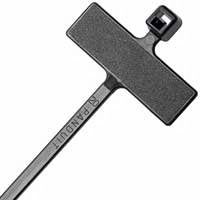
The photo below is what we used to use at NASA. This one is Black but you can get it in white and opaque. You can use permanent pen to write on the tabs. For instance "Mixer Out Left" on one end and "EQ In Left" on the other end. I like these because they don't peel off or fall out. I also have those numbered wrap around numbered ID stickers for the wires/cables. I do like the color tape though.
 

Attachments

  • Ty Wrap Marker.jpg
    Ty Wrap Marker.jpg
    4.6 KB · Views: 32
Ty-Wraps and heat shrink with identifying labels or writing are nice... I'm just thinking about our particular scenario. :)

Dunno about the rest but the innards of our rack rears are very dark inside. Placing a writen label beside jacks wouldn't help us much because there isn't room for them on the back of the components. That's why we use the tape.

In our rig we have processing in one case and amps in another. The frontend is in another case. The tape is easier to see and identify in dark places. Wolfie wears bifocals now... and reading small print while crawling on the floor is an exercise in contortionist skill. A skill I do not possess, unfortunately.

It works for what little patching of cases we have to do. If you're running a large sound board with snake, the tape won't be of much help. That's where labeled patch plugs are a necessity.
 
Ty-Wraps and heat shrink with identifying labels or writing are nice... I'm just thinking about our particular scenario. :)

Absolutely Wolfie, I live in the same dark world (much of the time). Glasses too!

My only thought on the shrink was to use the colored stuff to change the color of the individual conductors. Houston had banana plugs up top at the start. That got me thinking along those lines, it might be useful. Sorry Wolfie, I'm a real shrink fan!

There might not be as many that can use this idea but if you roll (build) your own cables, shrink around the outer jacket could be used to identify purpose. Black might be a standard cable, whereas yellow could identify a special purpose or diagnostic cable. White or yellow shrink provides a nice contrasting color to write on.

I didn't quite catch the tape's purpose the first time round but now see where you were going. Alternatively (another idea) the colored tape alone without writing can also be used to number cables. Resistor color code mnemonic: Bad Boys Rob Our Young Girls But Violet Gives Willingly

Bad Black 0
Boys Brown 1
Rob Red 2
Our Orange 3
Young Yellow 4
Girls Green 5
But Blue 6
Violet Violet 7
Gives Gray 8
Willingly White 9

It really is a matter of what you can most easily remember and what works for you.

By the way folks, I did go to the effort of (attempting) making columns for the colors but it didn't work out very well.
 
With Sound wiring is different than with electrical wiring.

Black is always negative, White is always positive!

with 4 conductor wire the black and green are neg the white and red are pos.

The rib is always on the negative side (so you can hookup in the dark)

With zip cord (and who uses that) the strip is pos.