Subs - 21" vs 18"

To many ads? Support ODJT and see no ads!
Status
Not open for further replies.
Music to my ears.

At 100Hz, a wavelength is 11.3ft long. So, separating the two by two wavelengths is 22.6ft. That's the minimum separation distance. After all these years, it still amazes me how few people are willing to spread tops by even that distance. So, cudos.

Also, you have a 4.5dB advantage for the subs (+3db) over the tops (-1.5dB). Again, cudos.

Based on the frequency spread of the crossover, the signal to the subs and tops are attenuated by:

Subs: 10* log(1.1oct/8.65oct) = -8.95dB
Tops: 10* log(7.55oct/8.65oct) = -0.59dB

So, the subs should be given just over an 8dB advantage relative to the tops...based on the signal strength that each type of cabinet will receive from the crossover. Even so, kudos for doing anything to help the subs out in this case. The mis-understanding of this signal issue from a crossover is the #1 cause of the "power hungry sub" myths.

Any article on setting gain structure that does not talk about this should be taken with a grain of salt. There is more on this method here:

http://www.prosoundweb.com/article/how_do_you_set_system_gain_structure/P8/

A lot of these chaps on here have no knowledge of gain structure, there are some who do but they are the exception. Most will tell you that they don't even have an EQ because it is not needed because their Powered Speakers have onboard processing, LOL. They fail to realize that each Venue has different acoustical properties and some may be very challenging. They claim that their system will work as is in every situation. For many years I have been trying to tell those who think that way that it ain't necessarily so but their comment is that "my Client liked it and everyone had a good time".
 
  • Like
Reactions: 1 person
A lot of these chaps on here have no knowledge of gain structure, there are some who do but they are the exception.

Yeah...I know. But just in case someone does...now, or when they find this thread in 6 months...there is a pointer to the correct information.
 
  • Like
Reactions: 2 people
A lot of these chaps on here have no knowledge of gain structure, there are some who do but they are the exception. Most will tell you that they don't even have an EQ because it is not needed because their Powered Speakers have onboard processing, LOL. They fail to realize that each Venue has different acoustical properties and some may be very challenging. They claim that their system will work as is in every situation. For many years I have been trying to tell those who think that way that it ain't necessarily so but their comment is that "my Client liked it and everyone had a good time".

If you're speaking of a GRAPHIC Eq, I believe most of us certainly know what they are. The problem I personally see with graphic eqs is that, on average, it's far too easy to over-use and wreck your overall sound as your ears get tired. Speaking only for myself, I rarely ever find problems with resonant frequencies in the vast majority of the rooms and in those cases it's best to just keep the eq chain a very simplistic bass-mid-high on the channel eq.
 
Yeah...I know. But just in case someone does...now, or when they find this thread in 6 months...there is a pointer to the correct information.
I agree! I am glad that YOU explained it the way you did. Had I said the very same thing there would be loads of resistance and I would be told that it is only MY opinion that it is not fact! I least I can give credit to you for speaking the facts!

- - - Updated - - -

it's best to just keep the eq chain a very simplistic bass-mid-high on the channel eq.
Are you talking about the Smiley Face or the Mountain Range with Everest in the Middle? :laugh:
 
  • Like
Reactions: 2 people
Don't let them try and talk you into the dual 18" (TX2181), they do not sound as good as a pair of TX1181, I think it is the boxes, the TX2181 is not in a box twice as big as the TX1181. I drove a TX2181 side by side with a pair of TX1181 and there was a noticeble difference in sound between the two. Plus the weight is more manageable on the singles and by adding more you have much more flexibilty on placement.

Thanks Ray J.

I own the entire Tour X line, and i agree this would be a GREAT option for Rick. From someone who own all of them, the Dual 18's are definitely the best sounding subs in the line. Amazing output and in my opinion much better tone quality. You have to be careful about trusting what you hear in Sam Ash, a lot of times they don't have things hooked up properly or powered by the proper wattage. With that being said, if you're working on your own then definitely go with the single 18's TX2181 and make sure you get the wheel kit for them as well. You can easily handle them by yourself and they look and sound GREAT. Also , when it comes to the decision between 18inch and 21 inch the saying " Bigger isn't better " actually applies. Stick with the 18's and i wouldn't recommend 21's unless you plan on getting into the higher end 21's that really have a really clean sound to them ( RCF has some of the best 21's out there for example but at a very high cost ). I should add Rick that our Tour X rig goes out probably more often then ANY of our other systems and i own RCF, And most of the EV Lines ( Live X, Tour X, Phoenix ). You wouldn't regret the purchase.
 
  • Like
Reactions: 1 person
If you're speaking of a GRAPHIC Eq, I believe most of us certainly know what they are. The problem I personally see with graphic eqs is that, on average, it's far too easy to over-use and wreck your overall sound as your ears get tired. Speaking only for myself, I rarely ever find problems with resonant frequencies in the vast majority of the rooms and in those cases it's best to just keep the eq chain a very simplistic bass-mid-high on the channel eq.

Graphic EQs are typically 31band EQs. I agree that they can be abused...by people who do not know what they are doing...but people who don't know what they are doing tend to mess up a lot more than just EQ.

"Room boom" or resonances are onlyh one issue that can be corrected with a 31 band EQ. ALL PA cabinets can benefit from EQ in order to produce a flat response (well, with 1dB of flat across the spectrum). This is my primary use of 31band EQ...to get a flat response from the system. This is a "set it and forget it" kind of thing. I do make minor changes for rooms...as needed....but I don't save them, so they disappear when I power down the PA manager.
 
"Room boom" or resonances are onlyh one issue that can be corrected with a 31 band EQ. ALL PA cabinets can benefit from EQ in order to produce a flat response (well, with 1dB of flat across the spectrum).

This is my primary use of 31band EQ...to get a flat response from the system.
Say that LOUDER, nobody heard you! LOL :hello2:
 
@lone - I'm actually pretty happy with my pair of jbl 18s. Not sure that changing over to the t cab 18s would gain anything. My ipr3000 that pushes the subs has never come close to clipping (880 watts per side) but my top (440 watts into 8 ohm cabs) occasionally will.

Sent from my DROID BIONIC using Tapatalk 4 Beta
 
  • Like
Reactions: 1 person
I also run a flat system it just sounds right. I use a digital eq that has a mic input so making adjustments is easy. I also like the fact that I can save presets for different venues.
 
  • Like
Reactions: 1 person
I use Bill Fitzmaurice's Titan 39's, 14" wide, BP102 loaded -

That website really has my attention. Thank you for such a great find. Did you build out your own cabs? Also, how did you determine the driver(s) to use? There is an approved cabinet builder that's about 1.5 hrs away so I think I'll shoot an email to get a price. For the same money (or less), I could afford to build out several cabs and have the added flexibility when I run into large room situations.
 
  • Like
Reactions: 1 person
That website really has my attention. Thank you for such a great find. Did you build out your own cabs? Also, how did you determine the driver(s) to use? There is an approved cabinet builder that's about 1.5 hrs away so I think I'll shoot an email to get a price. For the same money (or less), I could afford to build out several cabs and have the added flexibility when I run into large room situations.

I did build all my own cabinets...and rack cases. The decision process that I went through when picking cabinet designs was long and tortuous. I obsessed over TONS of details and specs and tradeoffs. In the end it came down to pack space and portability.

In the SUV I have 28" of clearance, and just enough length for two "stacks" of T39's. I also commonly bury subs under risers in ballrooms...most are 2ft risers...but only have about 20" of clearance by the time you account for the structure under the riser. All of that lead me to the narrowest subs possible...which is 14" with the BP102 driver. That gets me four cabinet inside the SUV...which is overkill for all but a handful of my gigs a year...and for those I need a 5x10 trailer to haul everything.

My previous subs were Klipsch KP-480's, which are single 18's in a 2ft cube on wheels. I could hold two inside the SUV. For about the same pack space, I get two T39's. Overall the output is about the same...but the T39's need about 1/4 the power to get there...and sound better. Bass from a folded horn and bass from a direct radiator are VERY different...and it can take some time to understand the differences.

The 3012LF did not exist when I was building, neither did the Lab12 version of the cabinet. Given what I know now...I'd build 20" wide Lab12 loaded subs. Two would have slightly MORE output than four of the version I have now. And I could still hide them under all the risers that I have ever encountered.

Keep in mind that DIY can be cheaper for materials...if you need more than four tops & four subs. Labor can eat into that price advantage quickly, if you are not building your own. If you only need a pair of tops and a pair of subs...it is REALLY hard to beat some of the entry to mid level offerings...especially if you need to buy any tools in order to build. I already had all the tools & skills needed to build. DIY has a poorly defined resale market....so selling your gear later might be an issue. DIY is also not "rider friendly" if you happen to do work that includes riders.

Even with all that...I would build again if I ever needed a new or different PA system. I have a set of SLAs cut out on the bench....waiting for more drivers right now. Those will be combined with a Tuba 18 as a "monitor" system for producing. I have a "vintage" (or maybe it's just "old") stereo receiver from college that has an internal crossover and sub output that I use to drive the speakers.
 
I did build all my own cabinets...and rack cases. The decision process that I went through when picking cabinet designs was long and tortuous. I obsessed over TONS of details and specs and tradeoffs. In the end it came down to pack space and portability.

In the SUV I have 28" of clearance, and just enough length for two "stacks" of T39's. I also commonly bury subs under risers in ballrooms...most are 2ft risers...but only have about 20" of clearance by the time you account for the structure under the riser. All of that lead me to the narrowest subs possible...which is 14" with the BP102 driver. That gets me four cabinet inside the SUV...which is overkill for all but a handful of my gigs a year...and for those I need a 5x10 trailer to haul everything.

My previous subs were Klipsch KP-480's, which are single 18's in a 2ft cube on wheels. I could hold two inside the SUV. For about the same pack space, I get two T39's. Overall the output is about the same...but the T39's need about 1/4 the power to get there...and sound better. Bass from a folded horn and bass from a direct radiator are VERY different...and it can take some time to understand the differences.

The 3012LF did not exist when I was building, neither did the Lab12 version of the cabinet. Given what I know now...I'd build 20" wide Lab12 loaded subs. Two would have slightly MORE output than four of the version I have now. And I could still hide them under all the risers that I have ever encountered.

Keep in mind that DIY can be cheaper for materials...if you need more than four tops & four subs. Labor can eat into that price advantage quickly, if you are not building your own. If you only need a pair of tops and a pair of subs...it is REALLY hard to beat some of the entry to mid level offerings...especially if you need to buy any tools in order to build. I already had all the tools & skills needed to build. DIY has a poorly defined resale market....so selling your gear later might be an issue. DIY is also not "rider friendly" if you happen to do work that includes riders.

Even with all that...I would build again if I ever needed a new or different PA system. I have a set of SLAs cut out on the bench....waiting for more drivers right now. Those will be combined with a Tuba 18 as a "monitor" system for producing. I have a "vintage" (or maybe it's just "old") stereo receiver from college that has an internal crossover and sub output that I use to drive the speakers.

Thanks for the insight. I've had some experience with a CV folded horn and loved it. I'm assuming these cabs would probably be in the same neighborhood and yes, there's a definite difference between that and radiators. While I do like a good DIY project, I just suck at woodworking and don't have a table saw so I'll probably just hire out the build then load the cabs myself. Couldn't care less about resale value. I just want the results and if these things pound like you're saying, wow. The 20" wide with 12s loaded sound really, really awesome. So what load (ohms) are you using and do you use the EP2500 bridged or channel mode? I'm tempted to put 8 ohm drivers in and hit a pair of these with 1200 watts each but I guess the safer bet would be 4 ohm drivers and hit each driver with a separate amp channel. Your thoughts?
 
Thanks for the insight. I've had some experience with a CV folded horn and loved it. I'm assuming these cabs would probably be in the same neighborhood and yes, there's a definite difference between that and radiators. While I do like a good DIY project, I just suck at woodworking and don't have a table saw so I'll probably just hire out the build then load the cabs myself. Couldn't care less about resale value. I just want the results and if these things pound like you're saying, wow. The 20" wide with 12s loaded sound really, really awesome. So what load (ohms) are you using and do you use the EP2500 bridged or channel mode? I'm tempted to put 8 ohm drivers in and hit a pair of these with 1200 watts each but I guess the safer bet would be 4 ohm drivers and hit each driver with a separate amp channel. Your thoughts?
Rick Ryan, if you are considering modular, meaning adding to a base setup as needed, if I were you I would use 8ohm speakers. You can use one , or a pair or couple a pair for each side (With a Jumper cable) which when connected in parallel will give you 4ohms per side. That is how I have designed my JBL Scoops. Mine are 16ohms each and when joined that gives me 8ohms per side pair. As long as the amp has enough headroom for whatever wattage and resistance you give it, all will be fine.
 
I did build all my own cabinets...and rack cases. The decision process that I went through when picking cabinet designs was long and tortuous. I obsessed over TONS of details and specs and tradeoffs. In the end it came down to pack space and portability.

In the SUV I have 28" of clearance, and just enough length for two "stacks" of T39's. I also commonly bury subs under risers in ballrooms...most are 2ft risers...but only have about 20" of clearance by the time you account for the structure under the riser. All of that lead me to the narrowest subs possible...which is 14" with the BP102 driver. That gets me four cabinet inside the SUV...which is overkill for all but a handful of my gigs a year...and for those I need a 5x10 trailer to haul everything.

My previous subs were Klipsch KP-480's, which are single 18's in a 2ft cube on wheels. I could hold two inside the SUV. For about the same pack space, I get two T39's. Overall the output is about the same...but the T39's need about 1/4 the power to get there...and sound better. Bass from a folded horn and bass from a direct radiator are VERY different...and it can take some time to understand the differences.

The 3012LF did not exist when I was building, neither did the Lab12 version of the cabinet. Given what I know now...I'd build 20" wide Lab12 loaded subs. Two would have slightly MORE output than four of the version I have now. And I could still hide them under all the risers that I have ever encountered.

Keep in mind that DIY can be cheaper for materials...if you need more than four tops & four subs. Labor can eat into that price advantage quickly, if you are not building your own. If you only need a pair of tops and a pair of subs...it is REALLY hard to beat some of the entry to mid level offerings...especially if you need to buy any tools in order to build. I already had all the tools & skills needed to build. DIY has a poorly defined resale market....so selling your gear later might be an issue. DIY is also not "rider friendly" if you happen to do work that includes riders.

Even with all that...I would build again if I ever needed a new or different PA system. I have a set of SLAs cut out on the bench....waiting for more drivers right now. Those will be combined with a Tuba 18 as a "monitor" system for producing. I have a "vintage" (or maybe it's just "old") stereo receiver from college that has an internal crossover and sub output that I use to drive the speakers.

The builder has recommended Kappalite 3012LF drivers. Looks like their sensitivity is 95db vs 88db for the LAB12. I'm also a bit torn over whether to go with a 4-ohm load (run 1 cabinet per amp side) or use an 8-ohm load, like Canute is recommending. I'm really wondering if 1 of these won't be enough for a lot of my weddings then pull out the 2nd for larger events. Your (and others) thoughts? BTW, first quote I've gotten back is $699/each for the T39, 20" with a Kappalite included, ready to plug-in.
 
Last edited:
So what load (ohms) are you using and do you use the EP2500 bridged or channel mode? I'm tempted to put 8 ohm drivers in and hit a pair of these with 1200 watts each but I guess the safer bet would be 4 ohm drivers and hit each driver with a separate amp channel. Your thoughts?

I never bridge my amps. Amps produce voltage. Unless you need additional voltage swing, there is no reason to bridge an amp. In (almost) all practical "mobile DJ" cases, there is no need to bridge an amp...it rarely makes more SPL, and increases the risk of blowing a driver by 4x (double the voltage swing will produce 4x the delivered current).

The horn path adds an additional 2ohms of impedance to the driver. This is the effect of the mass of air in the horn path preventing the free movement of the driver. With an 8ohm driver, that makes for a total of 10ohm impedance on the whole cabinet.

I typically run two per channel (5ohm parallel load), and use as many channels as I need. I have run four cabinets per channel (2.5ohm load)...but that's rare. Since I hard limit the BP102 driver to 45v (200W @ 10ohm), there are no issues running the amp too hard.
 
The downside to most horn loaded designs is the open horn (aesthetics). And the downside to many home built setups I've seen is that they look home built .. or maybe 70's vintage.

For parties, proms, dances, it doesn't mean squat, but I've found, at least around here, that the open designs have lost aesthetic favor from the more formal event goers .. and scoops, earthquakes, and even open horned tops just aren't looked at favorably .. a reason I sold off my older pieces (Yamaha Club 15s, JBL MP215s, and Mackie SRM150s).
 
The builder has recommended Kappalite 3012LF drivers. Looks like their sensitivity is 95db vs 88db for the LAB12. I'm also a bit torn over whether to go with a 4-ohm load (run 1 cabinet per amp side) or use an 8-ohm load, like Canute is recommending. I'm really wondering if 1 of these won't be enough for a lot of my weddings then pull out the 2nd for larger events. Your (and others) thoughts? BTW, first quote I've gotten back is $699/each for the T39, 20" with a Kappalite included, ready to plug-in.

Both drivers are excellent. The "naked" sensitivities matter quite a bit in a direct radiator style cabinet, but matter much less in a folded horn.

The Lab12 is typically $40-ish cheaper...but 16 pounds (25 lb -v- 9 lb) heavier compared to the 3012LF!!! If you are only getting 1 or 2 cabinets.....spend the $$$, save the pounds.

The quote seems really reasonable for a plug & play T39.
 
I never bridge my amps. Amps produce voltage. Unless you need additional voltage swing, there is no reason to bridge an amp. In (almost) all practical "mobile DJ" cases, there is no need to bridge an amp...it rarely makes more SPL, and increases the risk of blowing a driver by 4x (double the voltage swing will produce 4x the delivered current).

The horn path adds an additional 2ohms of impedance to the driver. This is the effect of the mass of air in the horn path preventing the free movement of the driver. With an 8ohm driver, that makes for a total of 10ohm impedance on the whole cabinet.

I typically run two per channel (5ohm parallel load), and use as many channels as I need. I have run four cabinets per channel (2.5ohm load)...but that's rare. Since I hard limit the BP102 driver to 45v (200W @ 10ohm), there are no issues running the amp too hard.

Okay, now you're really twisting me up. When you say "BP102" are you talking Eminence BP102 (cheap) bass guitar drivers? I've been bracing for some ultra-expensive, long-excursion drivers. So, you're suggesting using an 8-ohm driver instead of a 4? Admittedly, I'm behind where you guys are but lets say I use that Carvin 3800lx amp. With a 4-ohm driver, 1 cab per amp side, I'm hitting each cab with 1150 watts vs 700 watts if I'm using an 8-ohm driver. Obviously, 8-ohm cabs would let me stack 4 cabs off that one amp (2 per side) but for the gigs I typically do I have a hard time seeing the day I'll want more than 2 cabs on a gig. Educate me some more, please.
 
The downside to most horn loaded designs is the open horn (aesthetics). And the downside to many home built setups I've seen is that they look home built .. or maybe 70's vintage.

Duratex coating is EASY to roll on or spray on. This is the "modern" looking cabinet coating that most touring gear is using. Carpet (aka "rat fur") is so last century.

Here is a stack of four T39's with a V-plate. These are "hidden" behind a backdrop at the event.

253910_2080863861858_5524008_n.jpg

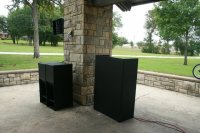
Here are two T-39's and my DJ facade at an outdoor event. You can see a DR200 on a stand peeking out from behind the stone column.

71680_1658162614591_2659917_n.jpg

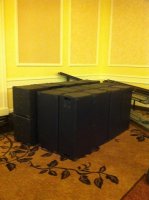
Here is a pile of T39's and DR200's during the load in at a large event. There are ten of each cabinet in that pile. This is a cell phone pic...so it's a little blury.

398758_3007502827253_831940433_n.jpg
 
  • Like
Reactions: 2 people
Status
Not open for further replies.