



Every DJ should have a Cable Tester. Here is a new Version. http://www.sweetwater.com/store/det...rce=email&utm_medium=email&utm_campaign=email
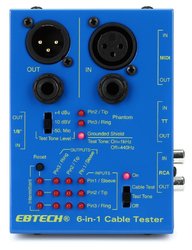


I really didn't look that deep into each one. The two that interests me are the Pyle pro and the Seismic; possibly now the Hosa since the Pyle pro is so large. I will be taking it on my gigs just in case something comes up so portability/size will matter. I like one that can test my speaker speakon cables, along with 1/4", RCA, and XLR. I'm assuming my speaker cables are the 2P or the 4P--how can I find out what type I have?I think if you look closely, the Nady, Seismic and Peavey are all made by the same manufacturer. The Hosa unit appears to be a better built unit. The Pyle Pro 40 is similar to another I saw (I forget the mfg). Bottom line is they're all pretty similar, so go with a good price and one that has the ports you need. For example, some have 2P/4P Speakon but not 8P (the one above has 8 pole). Some have cables we don't use as much (usb, optical digital, etc.). The Pyle Pros are pretty large and that might be a deterrent if you carry it as opposed to leaving it in the "shop".
Ok, I'm currently looking at my speaker cable and there is nothing on the cord or jack itself that says 2P or 4P. How can I find out wether I have a 2P speakon speaker cable or a 4P? (I'm aware that the cable tester uses the same jack for 2P/4P--I just would like to know for myself how to determine which type I have)The 2P (2 conductor) and 4P (4 conductor) use the same socket on the tester. The 8P (8 conductor) is larger and needs a different jack. You won't see many of those except in larger systems. So if it has a speakon jack, it will test either 2P or 4P equally.


I have one from EWI, but this one even tests Speakons ($40 on ebay) :
Ok, all of my speaker cables are the 2P kind. I wasn't aware of the different versions 2P/4P. When ordering online, by catalog, or by phone I really never took much attention; I just went with what was given to me. With that said, should I switch to a 4P speakon jack/cable for all of my speaker cables? What is the 4P advantage over the 2P and would it be significant?The 2p looks like this:
The 4P looks like this:
There are couple different versions of the 4 pole one, but they should look similar. The 2 pole has a rotate and lift lock, while the 4 pole versions have a tab/lever lock. Most cables today use the 4 pole/conductor version, even if they only use 2 conductors in the cable. The 2P one is cheaper (not by much) and is a little thinner.
That's good to know the difference between the pre-made 2P/4P cables; especially about the two separate signals in one cable for bi-amping--which I'm currently doing with my system using the 2P connector.No need .. they work the same. With the 4 conductor version you can have 2 separate stereo feeds in one cable, usually for bi-amping. You only NEED the 4P connector if you have 4 conductor (4 separate wires) cable and most pre-made cables are 2 conductor (standard stereo). If I was making a cable (and I've made most of my speaker cables), I would use the 4P connector, but I have bought both.
I'm currently using an external x-over. I have a 2P individual cable to each driver/speaker (2 tops) from amp, and use a 2P cable from amp to subs that are daisy chained in bridge mono. However, when I switch it off bridge mono to stereo and use four subs (2 subs daisy chained), one of the subs sounds muted. So I'm trying to find out if the problem is from the cables, speaker, or the connections. Thus, the search for a cable tester to check all of my cables for any errors to at least eliminate one problem.If you are bi-amping with a 2P connector, you'd have to run a separate cable for each driver. Using a 4 conductor cable and a 4P connector, many speakers (not all) have the ability to use a single 4P connector and access the 2 drivers separately (labeled +1, -1 and +2, -2).
