


Making your own cables

To many ads? Support ODJT and see no ads!
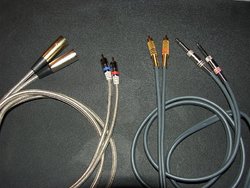
I try to make all my own cables both speaker and signal. Here are a couple that I have done.
customcableswy6.jpg
 
Making Your Own Cables, Be Careful.

I may do some repair but good cables are much cheaper now so I just replace. The key to making your own is proper soldering and the use of the proper wattage of a soldering iron. Too hot and it can melt the insulation and leave exposure of too much wire. Not hot enough and you can end up with "cold" solder joints.
Your solder should flow into the joints and wire, not pressed in hot (This can cause the joint to loosen up). Its a great idea to use flux to clean the joint and wire before applying the solder and then cleaning it up with pure alcohol afterwards to prevent deterioration.
I used to work at the Johnson Space Center assembling, fabrication and functional testing of the command consoles used in Mission Control. So I was NASA certified.
Remember, if you don't know what you are doing, trying to save a few bucks can cost you a blown speaker or worst yet an amp. (Not to mention the embarrassment and inconvenience if it happens at a gig!
I hope this helps.
 
Get good Kester brand solder, probably 60/40, rosin core (then you won't need to flux the parts, just tin them both first, then they'll solder together good) Get a smaller wattage iron, I use a 33watt I think. Don't use a huge soldering gun, get an iron with a small tip that you can get onto the connectors without touching other stuff and melting it.

I make all my own cables, saves me a lot of money, and I"ve got the time to do it in the evenings during the week anyway.

For your basic routine, I would tin the wires first, then tin the sockets. They'll still be hot and will take minimal reheat time to remelt and insert the wire. The solder on the tinned wire will melt immediately as you insert into the connection. Make sure you keep it very still while it's cooling or you'll get a questionable solder joint. You can see when it's cooled enough, the shiny melted solder will glaze over.
 
Clark or others, what does TIN mean??

Thats when you apply a coating of solder to the ends of the wire to ensure that the strands bind together. Its easier then to push the end into a terminal hole and make a wrap. Its also aids in the soldering process because its already primed.
 
Very Cool. What I want to do is make some Right Angle XLR patches and then solder them into the XLR rack mounts, SO my Mixer is ready to go at all times, more plug and play.

Make damn sure you orient those wires/conductors correctly!
 
There I fixed it for you. :sqlaugh: Yes you are correct with the above statements.

I re-read my posting, and I don't think I made a mistake that needed fixed?

If you don't keep it still while it's cooling, you will probably get a "cold" solder joint, which is definitely questionable.

Here is a fairly good video demonstration: YouTube - Soldering an XLR connector to an Audio Mic Cable

Where he says he might screw up the wires when inserting through the strain relief, you could strip the wires after you put it through, or you could tin them after you strip the plastic back but before you put through the strain relief.

Also, he uses a "helping hand" clamp, which will hold the wires still once you put the wires in and arrange them. Without that device, then filling the cup with solder and then reheating and inserting the wires works well also.
 
It's scary initially, specially if you have big fingers ;) but once you get the hang of it it get's a lot easier. I make my own cables just because it's fun to do. I can buy them cheap, but hey that takes all the fun out of it. Besides of all the wires I've made I have had zero failures (Knock on wood ;) )
 
The way they describe it, the "cold heat" soldering iron melts the solder when you touch the tip to it. To me this wouldn't make a very good electrical connection, because you must heat up the wire and connector to the same temperature as the melted solder to get a good "bond" of the solder to the connector or wire.
 
Sorry, I'm late to the dance... looks like you're in good hands. :) The only thing I will throw out (in the interest of having something to contribute) is that 60/40 solder is lead based. Now, I've used it for more than 20 years, with no issues... but with the RoHS standard out there, silver solders are becoming a lot more available and a lot cheaper. Some use antimony, etc... to keep the tin stable.
Pretty much everything else is covered (clean parts, even heat, etc). I have a jig I use, I'll try to post a pic of it tomorrow if I think of it. It's very helpful. :)

Ben