

Debate on Passive Vs Active Crossovers.

To many ads? Support ODJT and see no ads!

ahoustondj

Mac Daddy DJ
Aug 13, 2007
20,235
3,465
Texas
Reading the opinions on a recent thread which was unrelated to the thread itself, I have decided to open a new thread to discuss active vs passiver network configuration systems.
First, my own opinion. I have always believed that a passive crossover crossover system was used in speaker enclosure where there were two of more speakers. The crossover separated the frequencies coming from the amp going to each speaker. A single amp powered the whole thing.
An active crossover network was one where the signal from the source (Not the amp) was separated and then sent to each amp. That amp then amplified the dedicated frequency to it's corresponding driver.
The advantages of the active crossover was that you could have added live control of the frequencies sent to the amps. You could change the frequencies and also add or reduce gain of the individual signals going to the amp.
It seems to me that with the advent of powered speakers, the one that may have two or more amps within each enclosure, there is now a new class. It is neither true passive nor true active. it falls somewhere in between.
Given all things equal with a three way/ three separate types of drivers enclosure, I believe a true active electronic crossover will out perform the passive system any day.
Here are some articles for your sound nourishment.
http://sound.westhost.com/biamp-vs-passive.htm

http://www.crutchfield.com/S-aMkF0lt8KnL/learn/learningcenter/car/crossovers_faq.html

Audio crossover - Wikipedia, the free encyclopedia@@AMEPARAM@@/wiki/File:B-W_Matrix3MkII_FotoWeiche.jpg" class="image"><img alt="" src="http://upload.wikimedia.org/wikipedia/commons/thumb/6/62/B-W_Matrix3MkII_FotoWeiche.jpg/250px-B-W_Matrix3MkII_FotoWeiche.jpg"@@AMEPARAM@@commons/thumb/6/62/B-W_Matrix3MkII_FotoWeiche.jpg/250px-B-W_Matrix3MkII_FotoWeiche.jpg


http://www.marchandelec.com/xovers.html

Read the section that is titled "Powered Speakers" carefully.
http://www.electronichouse.com/article/print/active_passive_speakers/C201

I have always been an advocate of true tri-amp active crossover networks from as early as the late 70s. The sound is cleaner, more powerful and can be adjusted by individual frequences more easily that passive systems.

Some pics of Active crossover networks. Ashly & DBX makes some great ones. Check with Ben at NFLX for his inventory.
http://cachepe.zzounds.com/media/qu...s/S-3way-55387ce9b0e05248e35e46c3028e5739.jpg
 
Unless it's REALLY well designed, I believe you'll always get better performance from your cabinets if you can get rid of the passive crossover and implement the proper electronic crossover points, slope, and delay for the cone drivers, as well as CD Horn EQ for the horn loaded HF section (if it's a true CD horn). Normally the front loaded midrange or woofer will be electrically delayed to match it up with the horn. Ideally, all the drivers in the cabinet have the voice coils aligned in a vertical plane, then you don't need the delay, but that rarely happens unless you have a really short/small horn, then it's more likely a supertweeter than a real HF driver anyway.

The passive crossover isn't very efficient either, there is definitely signal loss just going through it.

I used to run a 4-way active PA, and I know that I always liked having the control to each frequency band with the electronic crossover and amp combinations. Wires directly to each driver from the amps is the most direct design you can get for getting the most sound to the speaker drivers. No passive crossover, no light bulbs for protection, nothing. Just know your system and set the amps right and implement limiters at the proper power levels (to protect from stupid mistakes mostly) and you'll be in good shape.

With the invention of small amps built into the cabinets, if they are really running seperate amps for each driver, then it's a good thing. All the settings can be built into the amp and it's a pretty much foolproof setup that will be hard to beat.
 
I beleive Mister Clark just ended this debate!

Sort of hard to argue with the absolute truth and fact!
 
With the invention of small amps built into the cabinets, if they are really running seperate amps for each driver, then it's a good thing. All the settings can be built into the amp and it's a pretty much foolproof setup that will be hard to beat.

Once things are set, its impossible to tweak the frequencies if needed in a live application. Yes, you can tweak your EQ but that changes the whole spectrum of the overall signal going to those enclosures.(This is true for both Active as well as Passive Networks)
Say for instance there is a lot of vocals being played in a song, overall volume is ok but more presence is needed in the vocals, you can tweak your midrange gain and or crossover points on your active network. You won't be able to do this with your passives or passives installed with amps in an enclosure.
 
Once things are set, its impossible to tweak the frequencies if needed in a live application. Yes, you can tweak your EQ but that changes the whole spectrum of the overall signal going to those enclosures.(This is true for both Active as well as Passive Networks)
Say for instance there is a lot of vocals being played in a song, overall volume is ok but more presence is needed in the vocals, you can tweak your midrange gain and or crossover points on your active network. You won't be able to do this with your passives or passives installed with amps in an enclosure.

So what your saying is the for each individual song, you'll tweak the crossover/amp gain settings? That seems quite tedious to me! I would hope that once the system is setup and balanced to the room, the mastered copies of the songs that are being played would sound good without additional tweaking.

Also, if you tweak the crossover/amps for the vocals, your tweaking for all the music being played also. Your changing the entire songs balance, not just the vocals. Any instrument that falls in that particular range will be brought out just as much as the vocals will.

However with live sound being my forte, I guess I never really ran into that scenario. I usually tweak the vocals with the parametric on the vocal channel. (I know, what am I doing on a DJ forum then, right?!)
 
So what your saying is the for each individual song, you'll tweak the crossover/amp gain settings? That seems quite tedious to me!

I did not say that at all, what i meant is if in a particular song, maybe it wasn't ripped correctly etc, thats when I would do my tweaking.


I would hope that once the system is setup and balanced to the room, the mastered copies of the songs that are being played would sound good without additional tweaking.

Exactly my point, how do you do a custom setup if your passives have already been done for you?
I hope that you understand that I am all in favor of 3 or 4 way "true" Electronic/Active network systems. Thats what I mainly use.
 
I've never used an active speaker. I'm very curious, but I'm hazy on how to operate them.

When running my passive rig I turn the attenuation all the way up on my power amplifier and adjust the volume with the mixer. Do you turn the powered speakers up all the way and adjust with the mixer just like with passive speakers?

I could see possibly getting a pair of powered speakers. It seems like it would make the load in easier by not having to carry an amp.
 
I hope that you understand that I am all in favor of 3 or 4 way "true" Electronic/Active network systems. Thats what I mainly use.

I understand completely, and I do miss having that capability, but only once in a great while. The system I have is a 3 way system, with passive in the tops. The passive crossover is quite complicated and exactly made for that particular cabinet/driver combination, and I see no need to change it because I'm very happy with the sound they have now (referring back to the statement if the crossover is properly designed) Other than the ones I have, I haven't heard many cabinets that do it as well or better, except the Danley tapped horn stuff. I'm sure there are lots of others out there, but I haven't experienced them.

And just for the record, I'm all in favor of the setup your talking about, straight wires to the drivers, nothing in between, but for simplicity sake, most people don't want to or can't deal with that much setup and tweaking. It takes a bit of knowledge and experience with crossover points, knowing what range your individual drivers sound good at, what slopes to use, do you want a butterworth or linkwitz-riley or bessel or even a chebychev, what order of crossover you want, what delay's to use, and so on...

If you can make it sound good, I applaud your enthusiasm and knowledge to get it done the "ideal" way!
 
I've never used an active speaker. I'm very curious, but I'm hazy on how to operate them.

When running my passive rig I turn the attenuation all the way up on my power amplifier and adjust the volume with the mixer. Do you turn the powered speakers up all the way and adjust with the mixer just like with passive speakers?

I could see possibly getting a pair of powered speakers. It seems like it would make the load in easier by not having to carry an amp.

Yup, pretty much that's it. You'll run a power cord and a signal cable to each cabinet. It's the same setup electrically, but the amp is in the speakers, not separate.

Before you go buy some, please be sure to demo them first. I have heard some that had an awful amount of noise (hiss) even with no signal present! I cannot specify what brand they were, I have no idea, but for an investment like a speaker system, you really should go rent if you can for a couple gigs to see if they are what your looking for.
 
A down side is available

Clark is spot on in his points but there is a downside to active crossover systems. If you don't know what you're doing it makes it much easier to make a system sound truly dreadful or to pop something. That's why the active speaker systems are so attractive. I don't know how many of you remember the old pizza commercial where the dumb new employee fresh from another company says, go to the shelf get the box (or can etc.). When someone uses an closed box active system like an Eon or Mackie all the decisions are made for them. A really bad decision isn't on offer. All you have to do is go to the shelf and get the box.

For the novice or non-technical, external active crossovers provide unlimited opportunity for bad decisions. I believe Fred has made this point before, the more options that are available, the greater the opportunity to make a system sound poor, no matter how good the components. The range of options for operating the system optimally is far more narrow.

As for tweaking, I'd much prefer to set the DSP per the manufacturer's settings. They will often give the specific type of filter (Butterworth etc.) crossover point(s) and the slope. They may additionally provide EQ information citing the center frequency, Q/Bandwidth and cut/boost (parametric eq) info for each boost/cut frequency. To each his own but this isn't anything I'd want to mess with while running a system. In the old days, lots of 1/3 octave equalizers or (line level) passive filter sets had solid covers over them. The uninitiated didn't even know it was there. Dbx Driveracks provide password protection for settings. I think there's good reason for doing so.
 
This is true. The aspect of bi- or tri-amping is dependent upon feeding each range of drivers with a dedicated signal. Hopefully, a signal that the driver is designed to reproduce. ;)

Passive crossovers do indeed waste some amp power. There are varied opinions on just how much difference it makes. But feeding a full range signal to a speaker system via passive crossover is not as efficient as using a bi- or tri-amped system with active crossover.

Some active speaker systems in the lower echelon are (or were) not truly bi- or tri-amped. This may have changed as active systems have improved by leaps and bounds over the past few years. The onboard EQ settings are used primarily to adjust to local acoustics.

A note about tweaking on the fly: It shouldn't be necessary. Once your active crossover and other processing are set correctly for the speaker systems you're using it shouldn't need to be monkeyed with. With prerecorded material like DJs use, some songs are going to be a bit muddier than others. In this case, your 3-band EQ on the mixer should be able to compensate for any variation.

Thoughts?
 
The only good passive crossover is the one in the garbage can :D:D:D:D:D it's easier to remove them, rewire the cabinet and enjoy the sound :D:D:D:D:D:D
 
Why I Use What I Use.

I see a lot of jocks looking at downsizing, buying smaller amps, lighter speakers, two way speakers etc. Let me draw a few points to your attention.
The difference in (Total Equipment) a three way active system (Minimum:2 bass cabinets, two midrange cabinets and two tweeter cabinets) vs a passive system (2 Two way mains plus 1 or 2 subwoofers) isn't really that much when you are referring to equipment.
3-Way Active System:
1. 2 Bass Cabinets
2. 2 Midrange Cabinets
3. 2 Tweeter cabinets
4. 3 Amplifiers
5. 3-Way electronic crossover
6. 3 Pairs of Speaker Cables
Note you can combine items #1., 2. and 3. into one cabinet with 3 input jacks or combine items #2. and 3. into one cabinet (Especially if you are using horns)

So now you have a total of either 10,8 or 6 components/pieces of equipment to load and setup plus speaker cables.

In an active system:
1. 2 Mains
2. 2 Sub Woofers (In my case I use 2 per side)
3. 2 Tripods
4. 2 Amplifiers
2 pairs of Speaker cables
So now you have a total 8 components/pieces of equipment to load and setup plus speaker cables.

Not much of a big difference is there?
Now lets talk about benefits.
First: Since its already agreed that a carefully selected Active 3 way system will sound more cleaner and powerful than a regular two way system with a sub(s), this is one of the features that will set you apart from the average DJ that walks in a venue with the regular rig.
Don't be afraid of the added power of the Active 3-way system. You can play it at low volumes and it would not be loud, just powerful
At higher gain, it will be more powerful not necessarily loud.
I have had people praise me on my system because they said things like "Gosh, I thought it was a band in here not a DJ!" You have now elevated your system to the ranks of "Live Sound". You no longer sound like any other DJ.
Second: Since you have set yourself apart from the others you can now demand more $$$$$$$ because you have more "stuff" which sounds way much better and is worth the extra dollars. (You can now afford to hire someone to help you with load in and setup etc.

This is what I have had working for me over the many years that I have been DJing. It is no wonder when you go to a Hall/ Hotel/ Whatever that the allocated space for a DJ is a little space with a table in a corner. The mindset is that all DJs are alike. When I fire up my rig, I no longer get lumped in with the rest. I get remembered and referred. Just thought I would share this with you all. Give me my brute force amps and 3 way active systems any day. I do have a few smaller systems but I use the larger system(s) whenever I can. The payoff is much better!
For those who are looking into active systems, I say "Go for it".
By the way, when I had mentioned tweaking my active crossover while playing I was referring to the individual gains. I'll have to post a pic of my Ashly SC-77.
 
And it isn't all gonna fit in a minivan, sorry. ;)

Agreed with the aspect of amp headroom. You can always turn it down. I'm a firm believer in the old adage ~ it's better to have it and not need it than to need it and not have it.

DJ space can be saved by doing what city planners have done for generations. When there's no room to build horizontal, build vertical. Rack your gear and stack the racks. Hang a custom drape over the rack stack and there's your system. You don't need banquet tables. :)
 
And it isn't all gonna fit in a minivan, sorry. ;)

Agreed with the aspect of amp headroom. You can always turn it down. I'm a firm believer in the old adage ~ it's better to have it and not need it than to need it and not have it.

DJ space can be saved by doing what city planners have done for generations. When there's no room to build horizontal, build vertical. Rack your gear and stack the racks. Hang a custom drape over the rack stack and there's your system. You don't need banquet tables. :)

I have a full size custom van and trailer hitch. Not having to haul crates of albums or CDs gives me more room.
 
Yah... there've been times when I wish we didn't have to load a CD case. I have been compiling a lot and reducing the case load. Making comps of artists and doing away with the one-hit-wonder CDs. :)

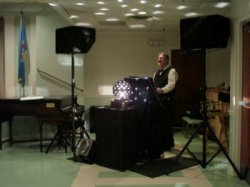
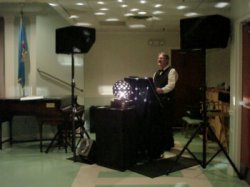
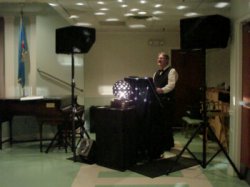
Our rig actually requires very little horizontal space. We set the sub cab(s) in front of the rack stack and one lighting effect sets on the sub. The tripod stands take up much of the space, it's a necessary evil. We usually have to ask the banquet captain or house manager to remove the table they've set up for us. We don't need no table, thanks anyhow. :)

The CD case sets on a four-poster Quik Lok stand that's situated to my right. This isn't our full monte rig, the dually 15" cabs are often overkill. But we have 'em in inventory if we need them.

Seems like every time we load the dually 15s, somebody calls the cops. :eek:
 

Attachments

  • rig02.JPG
    rig02.JPG
    28.2 KB · Views: 53
  • rig02.JPG
    rig02.JPG
    28.2 KB · Views: 53
  • rig02.JPG
    rig02.JPG
    28.2 KB · Views: 53
  • rig02.JPG
    rig02.JPG
    28.2 KB · Views: 53
Yah... there've been times when I wish we didn't have to load a CD case. I have been compiling a lot and reducing the case load. Making comps of artists and doing away with the one-hit-wonder CDs. :)

Our rig actually requires very little horizontal space. We set the sub cab(s) in front of the rack stack and one lighting effect sets on the sub. The tripod stands take up much of the space, it's a necessary evil. We usually have to ask the banquet captain or house manager to remove the table they've set up for us. We don't need no table, thanks anyhow. :)

The CD case sets on a four-poster Quik Lok stand that's situated to my right. This isn't our full monte rig, the dually 15" cabs are often overkill. But we have 'em in inventory if we need them.

Seems like every time we load the dually 15s, somebody calls the cops. :eek:

Looks good Fred. I don't use the double bass on each side as much, just one per side unless the hall is large. Each bass cabinet is 16ohms so it takes a lot to "wake them up"
 
Point of diminishing returns.

One thing that may be worth mentioning is, passive crossovers become increasingly impractical as power increases and frequency decreases. For sub-woofers only the least expensive moderate to low power systems can make practical use of a passive crossover.

The opposite is also true. At higher frequencies the power requirements are much lower because there is less energy in each successively higher octave. Add to that, the components can be much smaller and cheaper as the crossover frequency becomes higher. This makes second or third order (or more order) crossovers practical. Very high quality 3-way speaker systems (tops) are often designed for bi-amplification. The designers recognize as in most things there are diminishing returns. Sub-woofer and woofer design gains the most by utilizing an active crossover. The crossover from mids to tweets far less so.
 
One thing that may be worth mentioning is, passive crossovers become increasingly impractical as power increases and frequency decreases. For sub-woofers only the least expensive moderate to low power systems can make practical use of a passive crossover.

The opposite is also true. At higher frequencies the power requirements are much lower because there is less energy in each successively higher octave. Add to that, the components can be much smaller and cheaper as the crossover frequency becomes higher. This makes second or third order (or more order) crossovers practical. Very high quality 3-way speaker systems (tops) are often designed for bi-amplification. The designers recognize as in most things there are diminishing returns. Sub-woofer and woofer design gains the most by utilizing an active crossover. The crossover from mids to tweets far less so.

On my old system I ran 4-way active, but I did try to run passive to the mids/horns at one time. I purchased some 2way crossovers with 1600Hz @ 8ohms that were supposed to handle 500w continuous, and put them in the mid cabs, with a speakon jumper up to the horn cabinet. I added some hefty L-pads to tame down the HF horn, I cranked on it for about 20 minutes and the midrange didn't quit working, but started to sound funny. I smelled the magic smoke! I checked the crossover, yup, melted the plastic former and the wires were charred. I had let out the magic smoke that all electronic stuff works on and now it didn't work. I took them back out and tossed in the garage somewhere, never to be seen again!
I was only capable pushing about 550watts into each mid cabinet, and the amp was tickling the clip light periodically (PLX3402, 1 channel)

I ran 2 2402's bridged into 2 double 18's, and 3402 was in stereo, one channel on the 2 midbass cabs, one channel on the 2 midrange cabs. Then an Altec 600w amp on the 2 high cabs. That was one side, then I doubled that with another amp rack on the other side. I could push the system to the edge of clipping and it would still sound fine and never blew up a driver. Well, except for the one time I hooked it up totally backwards and sent 2400w of sub into the HF cab, that was an expensive mistake!

No, it wouldn't fit into a minivan, not even 2 of the 4 subs that weighed in at 265 pounds each...I had a hard time getting it all along with the lighting into a 17ft cargo truck.

Anyway, point is, when you get into higher power stuff, you rally can't go passive, it has to be active, then it just adds to the experience because you get ALL the power going to the speakers and not the passive devices in between. If you have the space, knowledge, and capability to go all active, then you'll probably hear a noticeable increase in your output more than likely, the speakers will come alive IF setup properly! Use decent size speaker wire too, I used 10G short runs for everything. My longest cable was about 8 feet.